
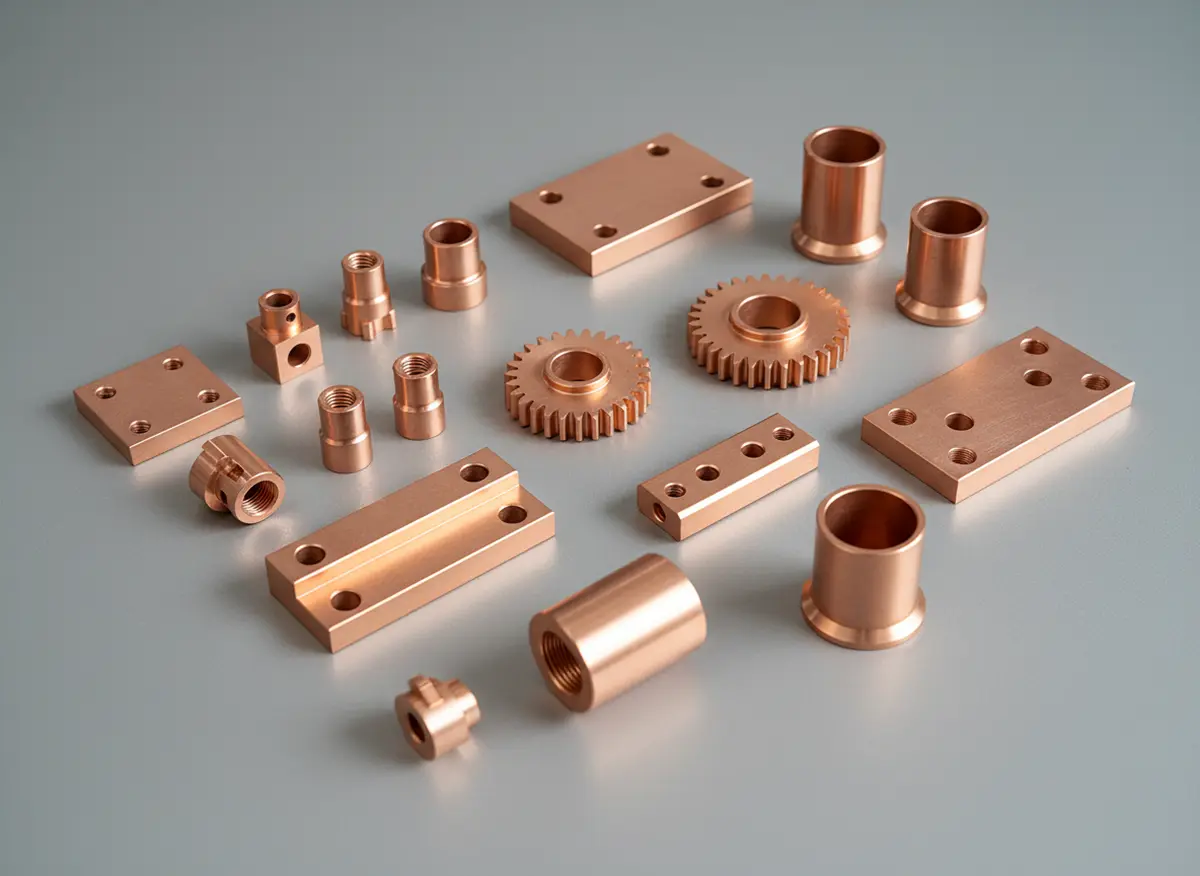
Copper is the material of choice for CNC-machined parts where electrical conductivity, thermal performance or both are non-negotiable. Commercially pure grades such as C101 and C110 deliver conductivity close to 100% IACS, making them the standard specification for busbars, RF connectors, heat spreaders, waveguides and precision electrical contacts across power, aerospace, medical and electronics applications.
This page covers everything needed to evaluate, specify and design CNC-machined copper parts — including grade properties and comparison data for C101 and C110, key material characteristics, design guidelines with minimum feature sizes and achievable tolerances, surface finishing options, industry applications and a full FAQ.
| Get a Copper Machining Quote → |
Copper Grades for CNC Machining — C101 and C110
Clarwe machines two commercially pure copper grades — C101 and C110 — covering the full range of precision electrical, thermal and structural copper applications. Both grades are oxygen-controlled, high-purity copper; the differences between them are oxygen content, purity level, machinability and cost, which together determine the right grade for a given application. Full mechanical and physical property data for both grades is in the Material Properties section below.
-
Copper C101 — Oxygen-Free Copper (CU OFE), ≥99.99% Cu
The highest-purity grade available at Clarwe. Near-zero oxygen content is the defining characteristic — it prevents hydrogen embrittlement at grain boundaries during welding, brazing and high-temperature joining. Specified for RF waveguides, magnetron anode blocks, microwave cavities, high-vacuum assemblies, vacuum feedthroughs and aerospace or defence components where oxygen-free purity is a drawing or procurement requirement. -
Copper C110 — Electrolytic Tough Pitch Copper (CU ETP), ≥99.9% Cu
The most widely used grade in general CNC machining. Slightly less pure than C101 but more machinable and lower in raw material cost, making it the practical default for the majority of copper projects. Specified for busbars, terminal blocks, grounding lugs, electrical connectors, heat spreaders, cold plates and power distribution hardware where maximum conductivity is required at an efficient cost.
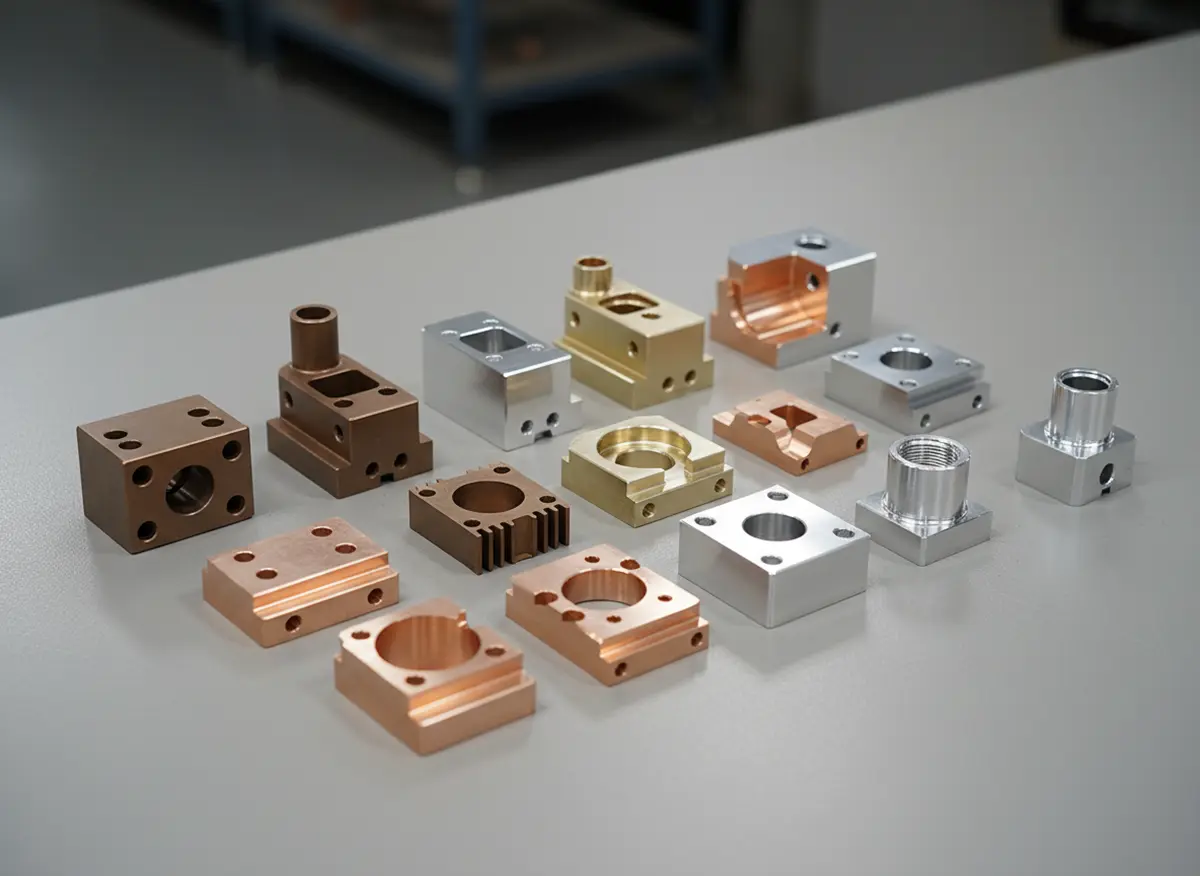
Material Properties of Copper
C101 and C110 Properties Comparison
The table below provides indicative mechanical and physical property data for Copper C101 and C110. All values are typical reference ranges; exact properties vary by temper, supplier, processing history and test method and should be treated as indicative only. For structural or safety-critical designs, confirm values against certified material test reports (MTRs).
| Property | Copper C101 (CU OFE) | Copper C110 (CU ETP) |
|---|---|---|
| Density (g/cm³) | 8.90 – 8.94 | 8.88 – 8.94 |
| Yield Strength (MPa) | 70 – 250 | 70 – 250 |
| Tensile Strength (MPa) | 220 – 340 | 210 – 380 |
| Elongation at Break (%) | 15 – 50 | 10 – 50 |
| Hardness (Brinell, HBW) | 60 – 90 | 40 – 110 |
| Fatigue Strength (MPa) | 90 – 120 | 50 – 80 |
| Electrical Conductivity (% IACS) | ≥101% | ≥99.9% |
| Thermal Conductivity (W/m·K) | 391 – 398 | 385 – 394 |
| Maximum Service Temperature (°C) | ~200 (continuous) | ~200 (continuous) |
| Melting Point (°C) | 1,083 | 1,083 |
Key Material Characteristics
The properties below explain how copper behaves in service and during machining, and why they are relevant to part design and grade selection.
-
Electrical conductivity— Pure copper is the highest-conductivity structural metal in common CNC use — significantly ahead of aluminium (~61% IACS), brass (~26–44% IACS) and stainless steel (~2–3% IACS). For parts where resistance in current-carrying paths must be minimised, no other standard CNC material competes. The minor difference between C101 (≥101% IACS) and C110 (≥99.9% IACS) is negligible for most electrical applications; grade selection is typically driven by oxygen content and fabrication method, not conductivity alone.
-
Thermal conductivity— At 385–400 W/m·K, copper transfers heat approximately twice as efficiently as aluminium (160–200 W/m·K). This makes it the first-choice material for cold plates, heat spreaders, vapour chamber bases and thermal interface components in high-power electronics, laser diode modules and power semiconductor assemblies where aluminium's thermal conductivity is insufficient.
-
Corrosion behaviour— Copper forms a stable cuprous oxide patina on exposure to air and moisture, providing self-protecting corrosion resistance in most indoor and moderate outdoor environments without coatings or conversion treatments. It is compatible with many industrial fluids but should be assessed for compatibility in immersed, acidic or high-chloride environments.
-
Mechanical characteristics— Both C101 and C110 are relatively soft and ductile compared to steel and brass. This allows complex features to be machined but requires attention to part rigidity, deflection and vibration in highly loaded or dynamically stressed applications. C110's wider hardness range (40–110 HBW versus C101's 60–90 HBW) reflects its broader range of available tempers — from fully annealed to half-hard and hard-drawn stock.
-
Machinability— Pure copper is a demanding CNC material. Its high ductility causes chips to smear and adhere to tool faces rather than breaking cleanly — a characteristic known as gummy cutting behaviour — which increases tool wear and can degrade surface finish. Sharp uncoated or TiN-coated carbide tooling, high positive rake angles, flood coolant and deliberate chip evacuation strategies are essential for clean results. C110 is generally more machinable than C101; the trace oxygen content in C110 acts as a minor chip-breaker, producing shorter, cleaner chips at equivalent cutting parameters.
-
Antimicrobial properties— Unlike most structural metals, copper actively destroys a wide range of bacteria, fungi and viruses on contact through the oligodynamic effect. This EPA-registered property is a functional design consideration — not just a material curiosity — for medical equipment components, surgical instrument parts, food-contact hardware and laboratory instruments where surface hygiene is a specification or regulatory requirement.
How Copper Compares to Other CNC Metals
When copper is under evaluation, it is almost always being considered alongside aluminium, brass or stainless steel. The table below gives a direct qualitative and quantitative comparison at the material level to support that decision.
| Property | Copper | Aluminium | Brass | Stainless Steel |
|---|---|---|---|---|
| Electrical conductivity | Highest — near 100% IACS | High — ~61% IACS | Medium — ~26–44% IACS | Low — ~2–3% IACS |
| Thermal conductivity | Very high — 385–400 W/m·K | High — 160–200 W/m·K | Medium — 100–130 W/m·K | Low — 12–25 W/m·K |
| Corrosion resistance | Good — self-protecting patina | Very good — oxide layer | Very good — plumbing and marine use | Excellent — aggressive environments |
| Machinability | Demanding — gummy, requires sharp tooling and coolant | Easy — excellent chip control | Very good — free-cutting grades available | Moderate to difficult — high tool loads |
| Density (g/cm³) | ~8.9 — heaviest | ~2.7 — lightest | ~8.4–8.7 | ~7.9–8.0 |
| Relative material cost | High | Low–Medium | Medium | Medium–High |
| Typical use case | Conductivity-critical, thermal management | Structural, lightweight, heat sinks | Connectors, fittings, moderate-conductivity parts | Structural, corrosion-critical, food-grade |
Copper is the right choice when conductivity or thermal performance is the primary design driver. When those requirements are absent, aluminium or brass will typically deliver a lower-cost, easier-to-machine part.
Choosing the Right Copper Grade for Your Application
The decision between C101 and C110 comes down to three factors: oxygen content, fabrication method and cost.
Choose C101 when your design involves:
-
Welded or brazed assemblies — near-zero oxygen prevents hydrogen embrittlement at grain boundaries
-
High-vacuum environments, vacuum feedthroughs or sealed enclosures where outgassing must be controlled
-
RF waveguides, magnetron anode blocks, microwave cavities or radar hardware where oxygen-free purity is a specification requirement
-
Aerospace or defence components where C101 is mandated by drawing or procurement standard
Choose C110 when your design involves:
-
Busbars, terminal blocks, grounding lugs and general power distribution hardware
-
Electrical connectors, relay contacts and wiring accessories
-
Heat spreaders and cold plates where vacuum-brazing is not required
-
High-volume production runs where material cost and machinability matter — C110 is the lower-cost, more machinable default for most copper CNC projects
| C101 or C110 — not sure which grade fits your project? Share your application — joining method, environment, conductivity requirement and any oxygen-free or aerospace specifications — and a Clarwe engineer will confirm the right grade before production starts. |
|
Upload Design for a Grade & DFM Review → Responded to within 2 hours. No obligation. |
Design Guidelines for CNC-Machined Copper Parts
Designing copper parts with machining constraints in mind reduces cost, shortens lead time and avoids quality issues at inspection.
Minimum Feature Sizes and Wall Thickness
| Feature | Recommended Minimum |
|---|---|
| Wall thickness — milled | 0.75 mm |
| Wall thickness — turned | 0.5 mm |
| End mill diameter | 0.8 mm |
| Drilled hole diameter | 0.5 mm |
| Depth-to-diameter ratio — drilled holes | 10:1 standard; up to 20:1 with step-drilling |
| Depth-to-diameter ratio — end mill pockets | Max 10× tool diameter |
| Internal corner radius | ≥ 1/3 of pocket depth; minimum 0.5 mm |
Achievable Tolerances
Clarwe machines copper parts to a standard tolerance of ±0.125 mm (±0.005 in). Tighter tolerances down to ±0.025 mm (±0.001 in)are achievable on critical features. Specify tight tolerances only on functional interfaces — bore diameters, mating faces and thread features — to avoid unnecessary cost on non-critical dimensions.
Threads, Undercuts and Internal Radii
-
Standard metric and UNC/UNF threads can be tapped directly in copper; thread inserts are not normally required.
-
Undercuts are achievable using square-profile, full-radius and dovetail tools — confirm unusual profiles with the engineering team at quoting.
-
Avoid sharp internal corners; a minimum 0.5 mm radius reduces stress concentrations and tool deflection.
Cost-Saving Design Tips for Copper CNC Parts
Copper is a premium material — typically 2–4× the cost of equivalent aluminium parts. These five design decisions have the highest direct impact on unit cost.
-
Use copper only where the properties are needed.If only one section of an assembly requires conductivity, consider a copper insert in an aluminium housing rather than machining the entire part from copper.
-
Default to C110 over C101.C101 is necessary only for welded assemblies, high-vacuum environments and RF/aerospace specifications. For everything else, C110 is more machinable, lower in material cost and the right default.
-
Reduce machined volume.Copper is priced and machined by volume removed. Cored pockets, thinner walls to the minimum recommended and near-net-shape stock all directly reduce cost — without changing function.
-
Minimise setups.Each additional setup adds machine time and datum-shift risk. Design parts with a single flat datum face where possible to allow complete machining in one or two setups.
-
Apply tight tolerances only where they matter.Specify ±0.025 mm only on functional interfaces — bore diameters, mating faces, electrical contact surfaces. Use the standard ±0.125 mm tolerance on all other features.
Surface Finishing Options for CNC-Machined Copper Parts
Copper's high reflectivity and chemical reactivity mean that surface finish selection directly impacts electrical conductivity, solderability, corrosion resistance and cosmetic appearance. Not all finishes applicable to aluminium or steel are suitable for copper — anodising and most conversion coatings are aluminium-specific processes and cannot be applied. The table below covers all available finishing options for CNC-machined copper parts, with guidance on typical thickness, functional effect and best-fit applications.
| Surface Finish | Typical Thickness | Key Benefit | Best-Fit Applications | Conductivity Impact |
|---|---|---|---|---|
| As-Machined | — | Fastest, lowest cost; Ra 1.6–3.2 µm | Heat spreaders, busbars, internal structural parts | None |
| Electropolishing | 2.5–25 µm removed | Mirror-bright finish; improved corrosion resistance | Medical instruments, semiconductor equipment, high-vacuum components | None |
| Silver Plating | 2–25 µm | Highest surface conductivity; excellent solderability | RF connectors, waveguides, microwave cavities | Maximised |
| Gold Plating | 0.1–5 µm (over nickel barrier) | Tarnish-resistant; consistent long-term contact resistance | Precision electrical contacts, connector pins, PCB edge connectors | Maintained |
| Nickel Plating(electrolytic or electroless) | 5–50 µm | Improved wear resistance and corrosion protection; barrier layer for gold | Industrial components, wear surfaces, pre-treatment before gold plating | Slightly reduced |
| Tin Plating | 5–25 µm | Excellent solderability at lower cost than silver or gold | Busbar terminations, connector contacts, power electronics | Maintained |
| Passivation / Chemical Brightening | Surface treatment only | Removes oxides; restores native reddish-orange colour | Aesthetic copper parts; pre-treatment before plating | None |
| Sandblasting / Bead Blasting | Surface texture only | Uniform matte finish; improves paint adhesion | Non-reflective surfaces, cosmetically consistent enclosures | Minor reduction at contact points |
| Hand / Mechanical Polishing | Surface treatment only | High-gloss decorative finish | Architectural hardware, decorative housings, optically critical surfaces | None |
Note: Powder coating is possible on copper but requires careful masking to preserve conductive surfaces. If your application requires a finish not listed above — such as ENIG (electroless nickel immersion gold) for PCB-adjacent components or chrome plating for decorative hardware — discuss requirements with the engineering team at the quoting stage.
|
Specifying a plated finish? Tolerances apply before or after coating. Upload your drawing with finish requirements — silver, gold, nickel or tin — and Clarwe will confirm thickness, masking needs and any impact on critical fits before quoting. |
Industry Applications for CNC-Machined Copper Parts
Copper's combination of conductivity, thermal performance, corrosion resistance and antimicrobial properties makes it the preferred material across several demanding sectors. The table below outlines the primary industries served and the typical components machined for each.
| Industry | Typical CNC-Machined Components | Preferred Grade |
|---|---|---|
| Electrical & Electronics | Busbars, terminal blocks, switchgear contacts, RF connectors, coaxial terminations, PCB test fixtures | C101 (RF/high-vacuum); C110 (power distribution) |
| Power & Energy | Transformer connectors, generator slip rings, grounding lugs, EV battery interconnects, charging connector housings | C110 (general); C101 (welded assemblies) |
| Thermal Management | Liquid-cooled cold plates, heat spreader plates, heat exchanger manifolds, vapour chamber bases | C110 (standard); C101 (vacuum-brazed) |
| Aerospace & Defence | RF waveguide cavities, magnetron anode blocks, radar components, antenna coupling elements | C101 (oxygen-free required) |
| Medical & Laboratory | MRI coil connectors, imaging components, vacuum feedthroughs, cleanroom instrument fixturing | C101 (electropolished, certified) |
| Automotive | EV powertrain interconnects, sensor housings, actuator contacts, ignition components | C110 (volume production) |
| Industrial & Semiconductor | EDM electrodes, vacuum chamber parts, sputter target fixtures, precision tooling inserts | C101 (EDM/vacuum); C110 (general tooling) |
Advantages and Limitations of Using Copper for CNC Machining
Copper's properties make it irreplaceable in certain applications — and unnecessarily expensive in others. The points below summarise where it earns its place in a design and where it may not.
Why Copper Is Specified for Precision CNC Parts
-
Unmatched electrical conductivity for a structural metal— For busbars, connectors and signal-critical paths, copper is the definitive choice when conductivity is the primary design driver. No common CNC material competes.
-
Superior thermal performance— At 385–400 W/m·K, copper handles heat nearly twice as effectively as aluminium — essential for cold plates and high-power thermal interfaces where aluminium falls short.
-
Good corrosion resistance without surface treatment— Copper's self-forming patina protects it in most service environments without anodising, painting or conversion coating.
-
Excellent solderability and platability— Accepts silver, gold, tin and nickel plating readily and is one of the most solderable base metals, simplifying downstream assembly.
-
Inherently antimicrobial— Unlike most structural metals, copper actively destroys pathogens on contact — an EPA-registered property relevant to medical, food-contact and laboratory hardware.
-
High ductility— Tolerates press-fit, swaged and crimped assembly operations without cracking.
Limitations and Trade-offs to Consider
-
Gummy cutting behaviour— High ductility causes chips to smear onto tools rather than breaking cleanly, increasing tool wear. Requires sharp carbide tooling and flood coolant.
-
High material and machining cost— Significantly more expensive than aluminium per kg and per cm³. Use copper only where its properties are genuinely required.
-
Weight— At ~8.9 g/cm³, approximately 3.3× denser than aluminium — relevant for weight-sensitive assemblies.
-
Thermal expansion— CTE of ~17 µm/m·K should be factored into assembly fits for components cycling across wide temperature ranges.
-
Prone to handling damage— Soft grades scratch and mark easily. Finish-critical parts require protective packaging.
Frequently Asked Questions
What copper grades does Clarwe machine?
Clarwe machines Copper C101 (oxygen-free, ≥99.99% Cu) and Copper C110 (electrolytic tough pitch, ≥99.9% Cu) as standard grades. For applications requiring a different alloy — including beryllium copper C17200 for spring contacts or high-strength tooling — contact our engineering team during quoting.
Which copper grade should I choose — C101 or C110?
Choose C101for welded or brazed assemblies, high-vacuum environments, RF waveguides, microwave cavities and aerospace or defence components where oxygen-free purity is specified.
Choose C110for busbars, terminal blocks, grounding hardware, electrical connectors, heat spreaders and any application where the purity difference from C101 is not functionally critical. C110 is more machinable and lower in cost — the default for most copper projects.
Why is copper harder to machine than aluminium or brass?
Pure copper's ductility causes chips to smear onto tool faces rather than fracturing cleanly — known as gummy cutting. Brass contains zinc which acts as a chip-breaker; aluminium has a lower work-hardening tendency. Machining copper successfully requires sharp carbide tooling, positive rake angles, flood coolant and deliberate chip management.
What tolerances are achievable on CNC-machined copper parts?
Standard tolerance is ±0.125 mm (±0.005 in)for general features. Tighter tolerances down to ±0.025 mm (±0.001 in)are achievable on critical features — bore diameters, mating faces and thread runouts. Specify tight tolerances only on functional interfaces to avoid unnecessary cost on non-critical geometry.
Can copper parts be welded or brazed after CNC machining?
Yes — with correct grade selection. C101's near-zero oxygen content prevents hydrogen embrittlement at grain boundaries during high-temperature joining, making it the correct choice for welded and furnace-brazed assemblies. C110 contains trace dissolved oxygen and is generally not recommended for fusion welding in reducing atmospheres, though silver brazing in open air is commonly practised.
What surface finishes are available for CNC-machined copper parts?
Available finishes include: as-machined, electropolishing, silver plating, gold plating, nickel plating (electrolytic or electroless), tin plating, passivation/chemical brightening, sandblasting and hand polishing. Anodising cannot be applied to copper. See the Surface Finishing section above for thickness ranges, conductivity impact and best-fit applications for each option.
What is the typical lead time for CNC-machined copper parts?
Standard lead time is under 10 business days for most geometries. Expedited options may be available depending on capacity and complexity — confirm at the quoting stage if you have a critical deadline.
What is the maximum part size Clarwe can machine in copper?
Clarwe's standard CNC milling envelope accommodates copper parts up to approximately 200 × 80 × 100 cm. CNC turning handles rotational parts within standard lathe swing and bar stock diameter ranges. For parts outside these envelopes or requiring 5-axis simultaneous machining, contact the engineering team with your CAD file for a capability review.
|
Ready to machine copper parts? |