
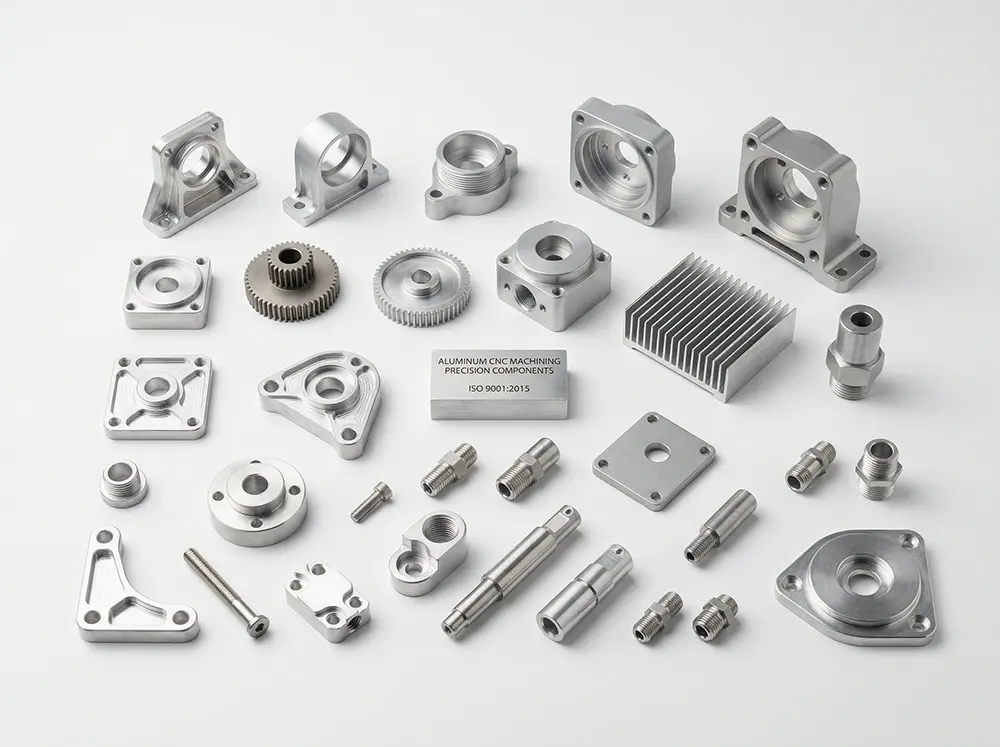
Aluminum is the most widely specified metal for CNC-machined parts . It serves as the default choice across the aerospace, automotive, electronics, and industrial sectors due to its low density (2.70–2.82 g/cm³), excellent machinability, and high tensile strength, which can reach up to 575 MPa in certain alloys. It also pairs perfectly with a broad range of surface finishes, including anodizing, hard coat, and powder coating.
To ensure your aluminum part performs reliably and remains cost-effective, you need to get three key decisions right:
- Alloy Selection: Alloys like 6061, 7075, 5083, and 2024 are not interchangeable. They have vastly different strength, corrosion resistance, and machining profiles.
- Temper Condition: Treatments like T6, T651, and T7351 will significantly alter the mechanical properties of your chosen base alloy.
- Surface Finish Sequencing: Processes like anodizing add measurable thickness to the part, which you must account for if your design has tight-tolerance features.
We cover all three of these considerations in detail below.
Aluminum At a Glance
| Available alloys | 2014, 2014-T6, 2017A, 2024-T351, 5052, 5052-H32, 5083-H111, 5083-H32, 6061, 6061-T6, 6061-T651, 6063, 6063-T5, 6063-T6, 6082, 6082-T6, 6082-T651, 7050, 7075-T6, 7075-T651, 7075-T7351, MIC6 |
| Standard tolerance | ±0.125 mm |
| Precision tolerance | ±0.025 mm (alloy and feature dependent) |
| Min wall thickness | 0.8 mm |
| Max part size (milling) | 600 × 300 × 200 mm |
| Max part size (turning) | 500(Dia) × 4000(L) mm |
| Lead time | 1–5 Days |
| Certifications | ISO 9001:2015 · AS9100D · ISO 13485:2016 |
| Get an Online Quote for Aluminum CNC Parts |
Why Aluminum Is Used for CNC-Machined Parts
Aluminum machines three to five times faster than most steels, which directly cuts down cycle times and per-part costs. You don't need specialist process controls to work with it—standard sharp carbide tooling, high spindle speeds, and typical flood or air-blast cooling work perfectly across all common alloys.
When you combine this easy machinability with a strength-to-weight ratio that beats steel for most structural applications, it's easy to see why aluminum is the default metal when weight, lead time, and finish quality are top priorities.
The properties that should drive your alloy selection:
- Strength: Yields range from 130 MPa (6063-T5) up to 575 MPa (7075-T6). Always match the alloy to your actual load case, as over-specifying a high-strength alloy will just add unnecessary cost.
- Corrosion resistance: The 5xxx and 6xxx series offer excellent natural corrosion resistance. The 2xxx and 7xxx series are highly susceptible to corrosion, so parts used in exposed environments will require anodizing or a chemical film coating.
- Machinability: Alloys like 6061 and 6082 machine easily and leave a pristine surface finish. High-strength alloys like 2024 and 7075 require sharper tooling and reduced feed rates.
- Weldability: The 5xxx and 6xxx series are fully weldable. The 2xxx and 7xxx series are not, so you will need to design for mechanical fastening if joining is required.
- Finish compatibility: All aluminum alloys can be anodized, but the 2xxx series produces inconsistent coloring due to its high copper content. Stick to the 6xxx series for cosmetic anodizing.
Aluminum Alloys for CNC Machining
We group aluminum alloys into series based on their primary alloying element. Just knowing an alloy's series instantly tells you a lot about its corrosion resistance, weldability, and how it will take a finish.
All values are indicative reference ranges for engineering-grade stock. Confirm against the specific supplier datasheet before finalising structural calculations.
2xxx Series — High Strength, Aerospace Grade
Primary alloying element: Copper. The 2xxx series offers the highest strength in the aluminum family and boasts excellent fatigue resistance. However, because of the copper content, it has poor corrosion resistance without a surface treatment like anodizing or Alodine. It also does not weld well, so you should plan for mechanical fastening. We generally advise against using this series for cosmetic anodizing, as the copper causes uneven coloring. Finally, keep in mind that its maximum continuous service temperature is around 125°C (specifically for 2024-T351) before you start seeing significant strength loss.
- Specify 2xxx when: You need a maximum strength-to-weight ratio or high fatigue resistance. It is ideal for aerospace structural components, load-bearing assemblies, and high-cycle mechanical parts.
| Material | Density (g/cm³) | Yield Strength (MPa) | Tensile Strength (MPa) | Elongation at Break (%) | Hardness (HBW) | Fatigue Strength (MPa) |
|---|---|---|---|---|---|---|
| Aluminum 2014 | 2.78–2.82 | 100–430 | 190–490 | 6–18 | 45–140 | 90–140 |
| Aluminum 2014-T6 | 2.80–3.0 | 400–430 | 460–500 | 7–13 | 130–150 | 120–140 |
| Aluminum 2017A | 2.75–2.80 | 110–280 | 200–420 | 6–18 | 55–120 | 90–130 |
| Aluminum 2024-T351 | 2.72–2.80 | 320–340 | 450–480 | 10–19 | 120–145 | 100–140 |
5xxx Series — Marine and Corrosion Resistant
Primary alloying element: Magnesium. This series is non-heat-treatable (it relies on strain-hardening) but offers outstanding natural corrosion resistance, especially in saltwater and marine environments. While it has lower overall strength than the 6xxx and 7xxx series, it features great weldability. Keep it away from sustained high heat, as 5xxx alloys typically only retain their mechanical properties up to 65–120°C.
- Specify 5xxx when: Your part will operate in marine, chemical, or high-humidity environments. 5083 is the industry standard for marine structures and pressure vessels, while 5052 is great for chemical tanks and formed sheet components.
| Material | Density (g/cm³) | Yield Strength (MPa) | Tensile Strength (MPa) | Elongation at Break (%) | Hardness (HBW) | Fatigue Strength (MPa) |
|---|---|---|---|---|---|---|
| Aluminum 5052 | 2.66–2.70 | 90–220 | 190–280 | 10–22 | 46–70 | 100–130 |
| Aluminum 5052-H32 | 2.65–2.70 | 170–200 | 210–260 | 10–20 | 55–65 | 110–125 |
| Aluminum 5083-H111 | 2.66–2.78 | 125–165 | 210–300 | 10–15 | 60–80 | 120–150 |
| Aluminum 5083-H32 | 2.65–2.70 | 230–260 | 310–340 | 9–15 | 80–95 | 110–170 |
6xxx Series — General Purpose (Most Widely Specified)
Primary alloying elements: Magnesium and Silicon. The 6xxx series is heat-treatable and offers the best all-around balance of strength, machinability, weldability, and corrosion resistance. It also yields the highest quality anodized finishes. 6061-T6 is the most commonly specified aluminum alloy for CNC machining globally, while 6082 is its European equivalent. These alloys retain useful strength up to about 150°C.
- Specify 6061-T6 or 6082-T6 as your default for general mechanical components, brackets, housings, frames, and fixtures. If you need top-tier cosmetic anodizing (like for architectural hardware), opt for 6063.
| Material | Density (g/cm³) | Yield Strength (MPa) | Tensile Strength (MPa) | Elongation at Break (%) | Hardness (HBW) | Fatigue Strength (MPa) |
|---|---|---|---|---|---|---|
| Aluminum 6061 | ~2.70 | 240–280 | 290–320 | 10–15 | 90–100 | 90–120 |
| Aluminum 6061-T6 | ~2.70 | 240–280 | 290–320 | 8–14 | 90–100 | 90–110 |
| Aluminum 6061-T651 | 2.70–2.71 | 240–280 | 270–320 | 10–17 | 90–100 | 95–110 |
| Aluminum 6063 | ~2.70 | 90–130 | 130–180 | 8–18 | 40–60 | 55–80 |
| Aluminum 6063-T5 | ~2.70 | 140–150 | 180–190 | 10–15 | 55–70 | 65–75 |
| Aluminum 6063-T6 | ~2.70 | 160–215 | 190–245 | 8–12 | 70–80 | 65–75 |
| Aluminum 6082 | 2.70–2.71 | 240–280 | 290–340 | 8–15 | 90–100 | 80–120 |
| Aluminum 6082-T6 | ~2.70 | 250–280 | 295–340 | 8–12 | 90–105 | 90–130 |
| Aluminum 6082-T651 | 2.70–2.71 | 260–310 | 300–340 | 8–12 | 89–95 | 90–120 |
7xxx Series — Highest Strength
Primary alloying element: Zinc. This heat-treatable series boasts the highest tensile strength of all aluminum alloys, closely approaching mild steel. The trade-off is poor weldability. Note that 7075-T6 is prone to stress corrosion cracking (SCC) in harsh environments; if that's a concern, specify the 7075-T7351 temper instead. The T7351 temper sacrifices about 15% of its strength but adds critical reliability in humid or exposed conditions. Avoid high heat, as 7075-T6 loses significant strength above 120°C.
- Specify 7075-T6 when: You have non-welded, low-corrosion applications where you need the absolute maximum strength-to-weight ratio. Use 7075-T7351 if SCC is a risk, or 7050 for thick aerospace plates that need high toughness.
| Material | Density (g/cm³) | Yield Strength (MPa) | Tensile Strength (MPa) | Elongation at Break (%) | Hardness (HBW) | Fatigue Strength (MPa) |
|---|---|---|---|---|---|---|
| Aluminum 7050 | 2.70–2.80 | 390–500 | 490–570 | 8–12 | 130–150 | 150–230 |
| Aluminum 7075-T6 | 2.80–2.82 | 480–505 | 540–575 | 7–11 | 140–160 | 150–170 |
| Aluminum 7075-T651 | 2.70–2.85 | 480–505 | 540–570 | 8–12 | 140–160 | 150–170 |
| Aluminum 7075-T7351 | 2.80–2.82 | 410–440 | 500–530 | 7–12 | 130–150 | 150–170 |
MIC6 — Precision Tooling and Jig Plate
MIC6 is a cast aluminum tooling plate known for its controlled flatness, tight thickness tolerances, and stress-free microstructure. It stays flat right off the machine without needing secondary stress-relief operations. Because it has lower tensile strength than wrought alloys, it shouldn't be used for structural load-bearing applications. It is strictly meant for ambient-temperature use.
- Specify MIC6 when: You are designing a tooling plate, fixture base, vacuum chuck, or precision reference surface where dimensional stability and perfect flatness matter more than outright strength.
| Material | Density (g/cm³) | Yield Strength (MPa) | Tensile Strength (MPa) | Elongation at Break (%) | Hardness (HBW) | Fatigue Strength (MPa) |
|---|---|---|---|---|---|---|
| Aluminum MIC6 | ~2.70 | 100–110 | 160–170 | ~3 | 65 | 50–60 |
Not sure which alloy to specify? Upload your drawing and our engineering team will confirm alloy selection, temper, tolerances, and finish options. |
Quick Alloy Selection Guide
Use the three steps below to move from application requirement to a shortlisted alloy. All property data is in the series tables above.
Step 1 — Start from your design priority
| Design priority | Start with |
|---|---|
| General structural parts, brackets, housings, fixtures | 6061‑T6 / 6082‑T6 |
| Maximum strength‑to‑weight, non‑welded, low corrosion risk | 7075‑T6 / 7075‑T651 |
| SCC resistance or thick‑section aerospace plate | 7075‑T7351 / 7050 |
| Marine, chemical, or high‑humidity environment | 5083‑H111 / 5052 |
| Tooling plates, fixture bases, precision reference surfaces | MIC6 |
| Cosmetic anodizing, architectural, or consistent colour finish | 6063‑T5 / 6063‑T6 |
Step 2 — Check the columns that matter for your load case
-
Yield and tensile strength— for load‑bearing capacity and safety margins.
-
Elongation at break— for ductility where forming, impact, or energy absorption is involved.
-
Fatigue strength— for high‑cycle or vibrating parts (actuators, rotating components, engine brackets).
-
Hardness (HBW)— as a proxy for wear resistance and surface durability.
Step 3 — Confirm process and finish compatibility
-
Welded joins required → stay within 5xxx or 6xxx series.
-
Cosmetic anodizing required → favour 6xxx, especially 6063 and 6061.
-
Corrosive or outdoor service without surface treatment → 5xxx series only.
-
Stress corrosion risk in high‑strength application → 7075‑T7351 over 7075‑T6.
|
If two alloys still appear equivalent after this pass, upload your drawing with a note on operating environment and load case. Our engineers will confirm the alloy, temper, and finish specification before you freeze the design. |
Design Considerations for Aluminum Parts
Use the following values as general design guidelines for CNC‑machined aluminum parts. Actual limits depend on alloy, part size, fixturing, and tooling. For designs that need to push beyond these ranges, Clarwe can review your CAD data and advise on achievable tolerances and potential design adjustments.
| Design aspect | Recommended guideline for aluminum CNC parts |
|---|---|
| Minimum wall thickness (standard) | ≈ 0.8 – 1.0 mm for most walls |
| Minimum wall thickness (feasible) | Down to ≈ 0.5 mm in localized areas |
| Maximum wall height‑to‑thickness ratio | Aim for ≤ 8:1 where possible |
| Minimum internal corner fillet radius | ≥ 0.5 – 1.0 mm in shallow pockets |
| Deep pocket fillet radius | At least 1/3 of pocket depth as a starting point |
| Practical minimum hole diameter (standard) | ≈ 2.5 mm |
| Practical minimum hole diameter (feasible) | Down to ≈ 1.0 mm with appropriate tooling |
| Threaded hole size | Prefer M3 and larger for most designs |
| Distribution of tight tolerances | Apply tight tolerances only to critical features |
Cost-Saving Design Tips for Aluminum CNC Parts
Small design decisions directly impact your machining time and per-part costs. Here are a few practical ways to reduce expenses without compromising your part's function.
- Apply tight tolerances selectively: Only specify precision tolerances (like ±0.025 mm) on functional mating features such as bores, pins, and critical interfaces. Applying blanket precision tolerances across an entire drawing just increases inspection time and cost without adding any engineering value.
- Watch your pocket depth-to-width ratios: Try to keep these within 4:1. Deep, narrow pockets require longer, more flexible tooling, which forces machinists to use slower feed rates and run extra finishing passes. If your design requires a depth exceeding 4x the width, consider step-drilling or a quick design review before committing.
- Consolidate features to minimize setups: Every time a machinist has to re-fixture a part, it adds time and introduces potential datum errors. Whenever possible, design your features so they can be accessed from a single orientation.
- Default to 6061-T6 or 6082-T6 for prototypes: Unless your load analysis confirms 7075 is absolutely necessary, stick to the 6000 series. 7075 stock is more expensive, machines slightly slower, and requires surface treatments in corrosive environments.
- Specify minimum thread engagement correctly: A reliable standard recommendation for aluminum is a thread engagement length between 1.5x and 2x the nominal thread diameter. Over-specifying thread depth, especially in thin walls, significantly increases the risk of tool breakage.
Surface Finish Compatibility
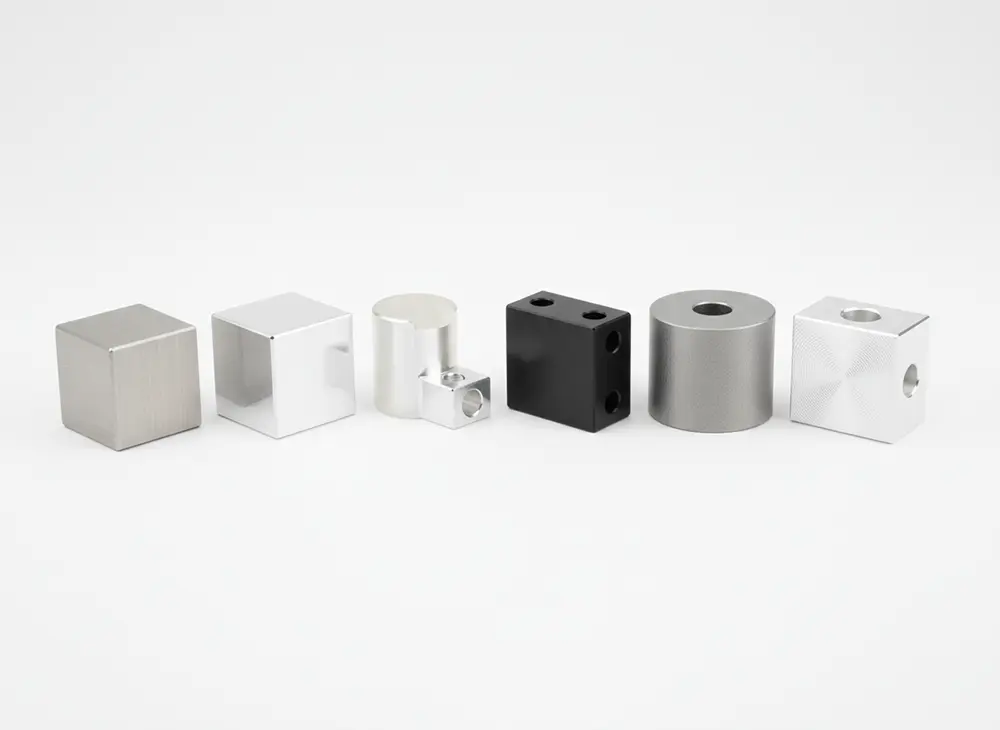
One of the main reasons aluminum is so popular for CNC machining is its compatibility with a massive variety of surface treatments. Here is a breakdown of the standard finishes we offer:
- As-machined: This leaves the part with no secondary treatment, typically resulting in an Ra 1.6–3.2 µm finish. It is perfectly suitable for internal components, structural brackets, and non-cosmetic parts where dimensional precision matters more than aesthetics.
- Bead blast: This creates a uniform, matte texture across all external surfaces. It removes machining tool marks and prepares the surface perfectly for anodizing. We commonly recommend this before Type II anodizing for cosmetic parts.
- Type II anodizing (sulfuric acid): This standard cosmetic and protective finish builds a 5–25 µm layer per surface, improving corrosion resistance and allowing for clear or colored dyeing. It is the go-to finish for 6061, 6082, and 6063 alloys. Tip: Stick to the 6xxx series for consistent, color-accurate results. The copper content in the 2xxx series tends to produce uneven coloring.
- Type III hard anodize (hardcoat): Hardcoat anodizing significantly increases surface hardness and abrasion resistance by building a 25–100 µm layer. It is frequently specified for wear surfaces, sliding interfaces, valve bodies, and aerospace structures. Keep in mind that this adds measurable dimensional growth. You will need to mask critical fits and threaded features, or pre-compensate for the growth on your drawing.
- Chemical conversion coating (Alodine / Chromate): This applies a thin, electrically conductive protective layer. It is essential when you need to preserve conductivity, such as in RF housings, EMI shielding components, and grounded assemblies. It is typically available in clear or gold.
- Powder coating: Ideal for color-critical and brand-driven exterior applications. It adds a relatively thick layer (60–120 µm), so be sure to clearly specify masking requirements for threaded inserts and precision mating faces on your drawings.
- Electroless nickel plating (ENP): ENP provides a uniform deposit, even inside internal bores and complex geometries. It is a great choice when you need both wear and corrosion resistance without sacrificing dimensional predictability.
A crucial note on finishing: When planning any surface treatment, always define your critical dimensions with the finishing sequence in mind. Processes like anodizing, powder coating, and plating add measurable thickness. You must account for this before machining if your design includes interference fits, precise bore diameters, or tight threaded regions.
View all surface finish options →
Industries and Applications
The same properties that make aluminum so easy to machine—its low density, predictable cutting behavior, and broad finish compatibility—are exactly why it fits perfectly into so many different service environments. Here is how we see it applied across major sectors:
- Aerospace and Defense: Flight hardware relies heavily on 2024-T351 and 7075-T6 for structural components like wing ribs, bulkheads, seat rails, and avionics housings. If your application involves thick sections or humid environments where stress corrosion cracking is a risk, swap to 7075-T7351. It sacrifices about 15% of its tensile strength but adds critical reliability.
- Automotive and Motorsport: For suspension components, gearbox housings, and lightweight brackets, 6061-T6 and 7075-T6 are the standards. Motorsport teams frequently push for 7075-T6 to shed maximum weight under high loads. General automotive applications tend to stick to 6061-T6 for its excellent weldability and lower cost.
- Electronics and Enclosures: The dominant alloys for RF shielding, heat sinks, and instrument frames are 6061-T6 and 6063-T6. If consistent cosmetic anodizing is your top priority, go with 6063. Its lower copper content produces a much more uniform color than 6061.
- Marine and Offshore: The 5xxx series is the undisputed choice here. 5083-H111 and 5052 provide excellent resistance to saltwater corrosion without needing surface treatments, and they are highly weldable for structural joins or field repairs.
- Medical and Laboratory Equipment: For medical device frames, surgical tools, and lab housings, 6061-T651 is the go-to. When designing precision test fixtures or vacuum chucks, MIC6 tooling plate is the standard, as it guarantees perfect flatness right off the machine.
- Industrial Tooling: Aluminum's machinability advantage directly reduces tooling lead times. We regularly use MIC6 for jig plates and machine beds where dimensional stability matters most, and 6082-T651 when those fixtures also need higher structural load capacity.
|
Supplying into a regulated industry? Clarwe holds ISO 9001:2015, AS9100D, and ISO 13485:2016 certification. Upload your drawing and our engineering team will confirm alloy, finish, and documentation requirements before production begins. |
Frequently Asked Questions
Which aluminum alloy is best for CNC machining?
Globally, 6061-T6 is the most widely specified option because it hits the sweet spot for strength, machinability, weldability, and anodizing quality. If you are in the UK or Europe, 6082-T6 is the functional equivalent. Only move to 7075-T6 if your design absolutely demands a maximum strength-to-weight ratio, as it is harder to weld and less corrosion-resistant.
What is the difference between 6061-T6 and 6061-T651?
Both are the same base alloy and temper, but the "T651" suffix means the plate was stress-relieved by controlled stretching after heat treatment. This reduces internal residual stress, preventing the part from warping or distorting during machining. For precision parts, large components, or thin walls, we highly recommend specifying T651 plate.
Does anodizing affect my part's dimensions?
Yes, and this is a common trap. Standard Type II anodizing adds 5 to 25 µm per surface, while Type III hardcoat adds 25 to 100 µm. Since the anodic layer grows both into the base metal and outward, your effective dimensional growth is roughly half the total layer thickness. Always account for this on your drawing or explicitly mask your critical fits and threaded regions.
Which aluminum alloys can I weld?
The 5xxx and 6xxx series (like 5052, 5083, 6061, and 6082) are readily weldable using standard TIG or MIG processes. Avoid welding the 2xxx and 7xxx series, as their copper and zinc content makes them highly susceptible to hot cracking. If you must use those alloys, design the assembly for mechanical fastening instead.
What tolerances can you hold on aluminum parts?
Our standard tolerance is ±0.125 mm for general features. If you need tight precision, we can confidently hold ±0.025 mm on functional mating faces, bores, and pins, depending on the specific geometry. Just keep in mind that pushing tolerances tighter than that usually requires secondary operations like grinding.
When Aluminum Is a Good Fit (And When It Isn't)
Aluminum is the right choice when:
- You need to minimize weight without paying a premium for titanium or carbon composites. It offers the best cost-per-kilogram strength-to-weight ratio of any common CNC metal.
- Lead times and per-part costs are priorities. Because it machines three to five times faster than steel, it directly reduces cycle times.
- You need built-in corrosion resistance or plan to apply protective finishes like anodizing.
- You are scaling from prototype to production, as it remains highly cost-competitive at volume.
Consider another metal when:
- Your part requires extreme surface hardness or abrasion resistance without secondary coatings. Look at alloy steels like 4140 or hardened stainless.
- Operating temperatures will consistently exceed 150°C. Aluminum loses strength progressively at high heat, making titanium or heat-resistant steel a much safer bet.
- You need maximum corrosion resistance in highly aggressive chemical environments without relying on surface treatments. Stainless Steel 316L is the standard here.
- You need the absolute highest rigidity-to-weight ratio and have the budget for titanium.
|
Ready to machine aluminum parts? |