
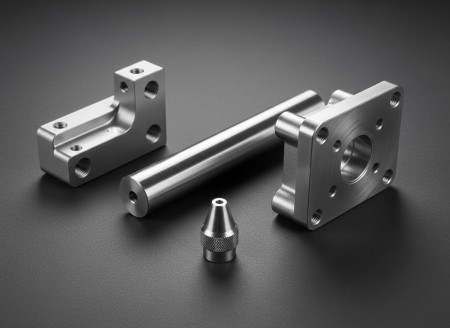
Stainless steel is one of the most widely specified metals for CNC machining when parts must perform in corrosive, hygienic, or structurally demanding environments. With yield strengths ranging from 205 MPa in standard austenitic grades to over 1,170 MPa in precipitation-hardening alloys, it covers an unusually wide performance envelope from a single material family.
Unlike aluminum, stainless steel maintains its strength at elevated temperatures and resists surface degradation from moisture, steam, cleaning agents, and chloride-bearing media. This makes it a direct choice for components that need long service lives without coatings or plating - in sectors from medical devices and food processing to marine systems and industrial automation.
|
DFM feedback in 2 hours, no obligation |
Key reasons engineers specify stainless steel for CNC parts
- Self-healing passive layer - the chromium oxide film reforms when scratched, maintaining corrosion resistance without surface treatments
- Wide strength range - from ~200 MPa (304 annealed) to over 1,300 MPa (17-4 PH H900), covering light brackets to high-fatigue structural parts
- Temperature stability - retains mechanical properties from cryogenic conditions to ~870°C depending on grade
- Hygienic surfaces - can be machined and finished to Ra values compatible with food, pharmaceutical, and medical sterilization standards
- No coating dependency - unlike carbon steel, stainless resists rust in its bare machined state, reducing finishing cost and lead time
Stainless steel grades used in CNC machining for machined parts
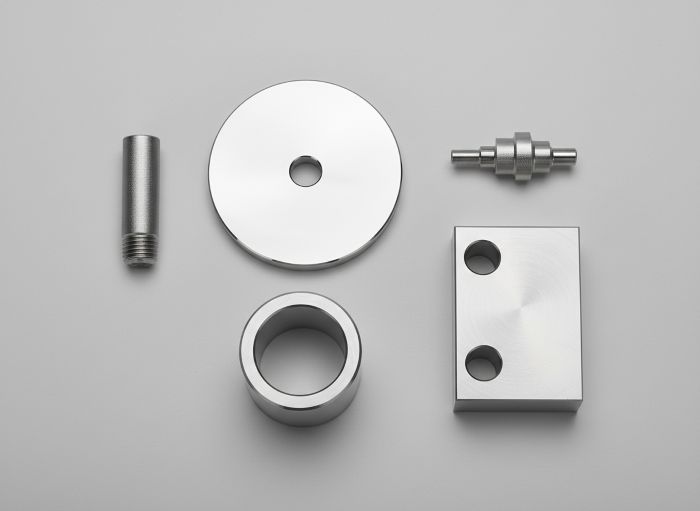
The table below compares mechanical properties and relative machinability across the stainless grades Clarwe regularly offers - use it alongside the grade selection table further down the page.
| Material | Density (g/cm³) | Yield Strength (MPa) | Tensile Strength (MPa) | Elongation at Break (%) | Hardness (Brinell) (HBW) | Fatigue Strength (MPa) | Machinability (%) | EN Equivalent |
|---|---|---|---|---|---|---|---|---|
| SS 2205 | 7.8 - 7.85 | 450 - 550 | 620 - 760 | 25 - 30 | 260 - 293 | 350 - 450 | ∼45 | 1.4462 |
| SS 303 | 7.9 - 8 | 240 - 420 | 600 - 750 | 35 - 50 | 160 - 230 | 230 - 300 | ∼78 | 1.4305 |
| SS 304/18-8 | 7.9 - 8 | 205 - 250 | 500 - 700 | 40 - 60 | 129 - 201 | 240 - 280 | ∼45 | 1.4301 |
| SS 316 | 7.9 - 8 | 170 - 310 | 480 - 620 | 40 - 60 | 140 - 190 | 240 - 310 | ∼40 | 1.4401 |
| SS 416 | 7.7 - 7.8 | 275 - 450 | 520 - 860 | 10 - 30 | 200 - 300 | 250 - 450 | ∼85 | 1.4005 |
| SS 410 | 7.7 - 7.8 | 375 - 450 | 480 - 700 | 16 - 30 | 180 - 220 | 190 - 350 | ∼55 | 1.4006 |
| SS 420 | 7.7 - 7.8 | 350 - 1400 | 650 - 1700 | 8 - 25 | 200 - 500 | 220 - 670 | ∼50 | 1.4028 |
| SS 430 | 7.7 - 7.8 | 260 - 370 | 450 - 620 | 20 - 35 | 150 - 200 | 170 - 210 | ∼54 | 1.4016 |
| SS 440C | 7.75 - 7.8 | 450 - 1900 | 700 - 2000 | 2 - 14 | 200 - 280 | 260 - 840 | ∼34 | 1.4125 |
| SS 15-5 | ∼7.8 | 860 - 1170 | 1030 - 1170 | 8 - 12 | 310 - 390 | 350 - 650 | ∼50 | 1.4540 |
| SS 17-4 | ∼7.8 | 1000-1170 | 1170-1310 | 8 - 12 | 350 - 400 | 550 - 700 | ∼45 | 1.4542 |
| Not Sure Which Grade Fits Your Part? Ask Our Engineers |
Austenitic stainless steels (304, 316 and similar)
Austenitic stainless steels are widely used due to their combination of corrosion resistance, formability, and non‑magnetic behavior in the annealed condition. Grades such as 304 and 316 are common for components in food processing, medical devices, consumer products, and general industrial equipment.
Note on work hardening: Austenitic grades such as 304 and 316 work-harden rapidly at the cutting zone. Surface hardness can increase 20–30% during a single pass, accelerating tool wear and degrading surface finish on subsequent cuts. This is why consistent feed rates, sharp tooling, and avoiding tool dwelling or rubbing are critical when machining these grades. Free-machining variants like 303 were specifically developed to reduce this tendency.
Ferritic stainless steels (430 and similar)
Ferritic grades such as 430 contain chromium but little or no nickel, making them magnetic and less expensive than austenitic alloys. They offer moderate corrosion resistance and good oxidation resistance at elevated temperatures, but cannot be hardened by heat treatment. In CNC machining, ferritic grades are easier to machine than austenitic types but their machinability rating is still low (~54%) due to work hardening and chip control challenges.
Free‑machining and martensitic grades (303, 416, 420, 440C)
Free‑machining grades such as 303 and 416 contain sulfur additions that improve chip breaking and machinability, which can reduce machining time and tooling cost. Martensitic steels like 410, 420, and 440C can be hardened and tempered, and are often used where a combination of strength, hardness, and moderate corrosion resistance is required.
Duplex and precipitation‑hardening steels (2205, 17‑4, 15‑5)
Duplex stainless steels such as 2205 combine relatively high strength with good resistance to stress‑corrosion cracking and pitting in chloride‑containing environments. Precipitation‑hardening grades like 17‑4 PH and 15‑5 allow heat treatment after machining to reach very high strength levels while maintaining useful corrosion resistance.
Typical applications and industries
Industrial and mechanical components
Stainless steel CNC parts are common in machinery, automation systems, and general mechanical assemblies, including shafts, spacers, wear plates, couplings, and brackets. These components benefit from good fatigue performance, dimensional stability, and resistance to everyday industrial environments.
Fluid handling, valves, and process equipment
Many valves, pumps, manifolds, and fittings are machined from stainless steel to withstand water, steam, oils, and mild chemicals. The material’s corrosion resistance helps maintain sealing surfaces and threaded connections over long service lives.
Marine, outdoor, and structural hardware
In marine and outdoor applications, stainless steel is used for structural parts, fasteners, and hardware that encounter saltwater, spray, and changing weather. Grades with better pitting and crevice corrosion resistance, such as 316 or duplex variants, are often preferred in these conditions.
Medical, food, and hygiene‑critical parts
Smooth, corrosion‑resistant surfaces and compatibility with cleaning or sterilization make stainless steel suitable for medical devices, food‑contact components, and laboratory equipment. Austenitic grades such as 304, 316, and 316L are frequently used where hygiene and regulatory requirements must be satisfied.
Aerospace and high‑performance assemblies
Precipitation‑hardening stainless steels (e.g., 17‑4 PH, 15‑5) and certain martensitic grades are found in aerospace and other high‑performance assemblies. These materials support high specific strength, good fatigue behavior, and reliable corrosion resistance in demanding operating environments.
Design considerations for CNC stainless steel parts
Wall thicknesses and feature proportions
Very thin walls in tough austenitic grades can be more difficult to machine without distortion or chatter. Slightly increased wall thickness and the use of fillets where possible help improve rigidity, dimensional consistency, and surface quality.
Tolerances, flatness, and stability
Tight tolerances and flatness requirements are achievable but may increase machining time and inspection effort. This is particularly relevant for long, slender parts or features that are sensitive to residual stresses and heat input.
Threads, small features, and deep pockets
For tapped holes in stainless steel, standard practice is to limit thread depth to 1.5× the nominal diameter to control tap breakage risk. For deep pockets, a depth-to-width ratio of 4:1 or less is recommended to maintain tool rigidity and coolant access. Wherever possible, design internal radii to match standard end mill diameters to avoid custom tooling requirements.
Surface finishes on stainless parts
CNC machining delivers a range of surface finishes on stainless steel depending on toolpath, cutting parameters, and post-processing. As-machined stainless surfaces typically achieve Ra 1.6–3.2 µm; finishing passes can refine this to Ra 0.8 µm or better. Bead blasting produces a uniform matte texture at Ra 1.6–3.2 µm, suitable for general industrial and consumer applications. Electropolishing and mechanical polishing can reach Ra 0.4 µm or below, commonly specified for medical, food-contact, and high-pressure fluid components. Passivation does not alter surface roughness but removes free iron and enhances the chromium oxide passive film to improve corrosion resistance.
Grade selection quick reference
| Use Case | Recommended Grade | Reason |
|---|---|---|
| General indoor industrial parts | 304 / 18-8 | Good corrosion resistance, widely available, lower cost |
| Marine or chloride environments | 316 / 2205 | Better pitting and crevice corrosion resistance |
| High-volume turned parts, cost-critical | 303 / 416 | Free-machining, reduced cycle time and tooling cost |
| Food contact, sterilizable surfaces | 316L | Low carbon, compatible with cleaning and passivation |
| High-strength structural or aerospace | 17-4 PH / 15-5 PH | Heat-treatable to very high strength with good toughness |
| Wear-resistant, cutting instruments | 440C | Highest hardness after heat treatment in stainless family |
| Outdoor, mildly corrosive, budget-sensitive | 430 | Moderate resistance, no nickel, lower material cost |
| Upload Your CAD for a Free DFM Review |
Machining stainless steel: cost and process considerations
Stainless steel CNC parts typically cost more per unit than equivalent aluminum parts due to longer cycle times, higher cutting forces, and faster tool wear. The following guidance helps control that cost without compromising part performance.
Design choices that reduce cost
Cost can often be reduced by simplifying geometry, avoiding very deep narrow features, and selecting surface finishes that match functional requirements rather than over‑specifying cosmetic quality. Choosing a stainless grade that is well‑matched to the environment, rather than over‑alloyed, can also help control material and machining cost.
Tooling and process considerations for stainless steel
Stainless steel's low thermal conductivity (roughly one-third that of carbon steel) concentrates heat at the cutting edge, accelerating tool wear and promoting built-up edge formation. Carbide tooling with TiAlN or TiCN coatings is the standard choice for CNC milling and turning of most stainless grades. Sharp, positive rake angles reduce cutting forces and limit the work-hardening layer at the cut surface. Maintaining consistent feed rates without dwelling or rubbing is essential - particularly for austenitic grades - to prevent surface hardening that resists subsequent passes. Flood coolant or high-pressure coolant is typically applied to stainless CNC operations to manage heat and support chip evacuation.
Stainless steel CNC machining at Clarwe
Clarwe offers stainless steel components across the full grade range - from standard austenitic 304 and 316 to precipitation-hardening 17-4 PH and 15-5 PH - using 3-axis and multi-axis CNC milling and turning. Our manufacturing partner facilities handle both prototype quantities, and production runs with quality assurance processes operating under ISO 9001:2015, AS9100D, and ISO 13485:2016.
We work with customers on material selection and DFM review before machining starts, which helps identify grade substitutions, geometry changes, or finish specifications that improve part performance and reduce cost. For critical stainless components in medical, aerospace, or process environments, our team can advise on compatible surface treatments and inspection requirements.
Tolerances and quality on stainless parts
General machined tolerances on stainless steel follow ISO 2768 medium (m) as standard. Tighter tolerances are achievable on features with stable cross-sections and appropriate wall thickness; these are confirmed at DFM review. Surface roughness is specified per drawing and verified on inspection. Material traceability and certificates of conformance are available for all stainless grades on request.
| Request a Prototype or Production Quote |
Frequently Asked Questions
Which stainless steel grade is best for CNC machining?
The best grade depends on environment, strength, and cost requirements. For general parts, 304 is a common choice; for marine or chemical exposure, 316 or duplex 2205 offer better corrosion resistance. For high‑strength or wear‑critical components, grades like 17‑4 PH, 15‑5, 410, or 420 are often selected.
Is stainless steel harder to machine than aluminum?
Yes — stainless steel requires lower cutting speeds, higher cutting forces, and more robust carbide tooling than aluminum, which increases cycle time and part cost. Free-machining grades like 303 or 416 reduce this gap significantly.
How does stainless steel affect CNC part cost?
Stainless steel CNC parts typically cost more than similar aluminum or mild steel parts due to lower machinability and higher material price. Tough, work‑hardening grades and complex geometries increase cycle time and tool wear, further driving up cost. Costs can be reduced by simplifying features, specifying realistic tolerances and finishes, and choosing a grade that is sufficient rather than over‑alloyed.
How corrosion resistant are CNC stainless steel parts?
CNC stainless parts have excellent corrosion resistance thanks to their chromium‑rich passive film. Austenitic grades like 304 perform well in many indoor and outdoor environments, while 316 and duplex 2205 offer superior resistance in marine, chloride, and process applications. Proper finishing and treatments such as passivation or electropolishing can further enhance corrosion performance.
What surface finishes are available for stainless steel CNC parts?
Common finishes include as‑machined, bead‑blasted, brushed, and polished surfaces tailored to functional or cosmetic needs. Additional options such as tumbling, passivation, and electropolishing can improve appearance, smoothness, and cleanability for food, medical, or high‑end consumer applications.