
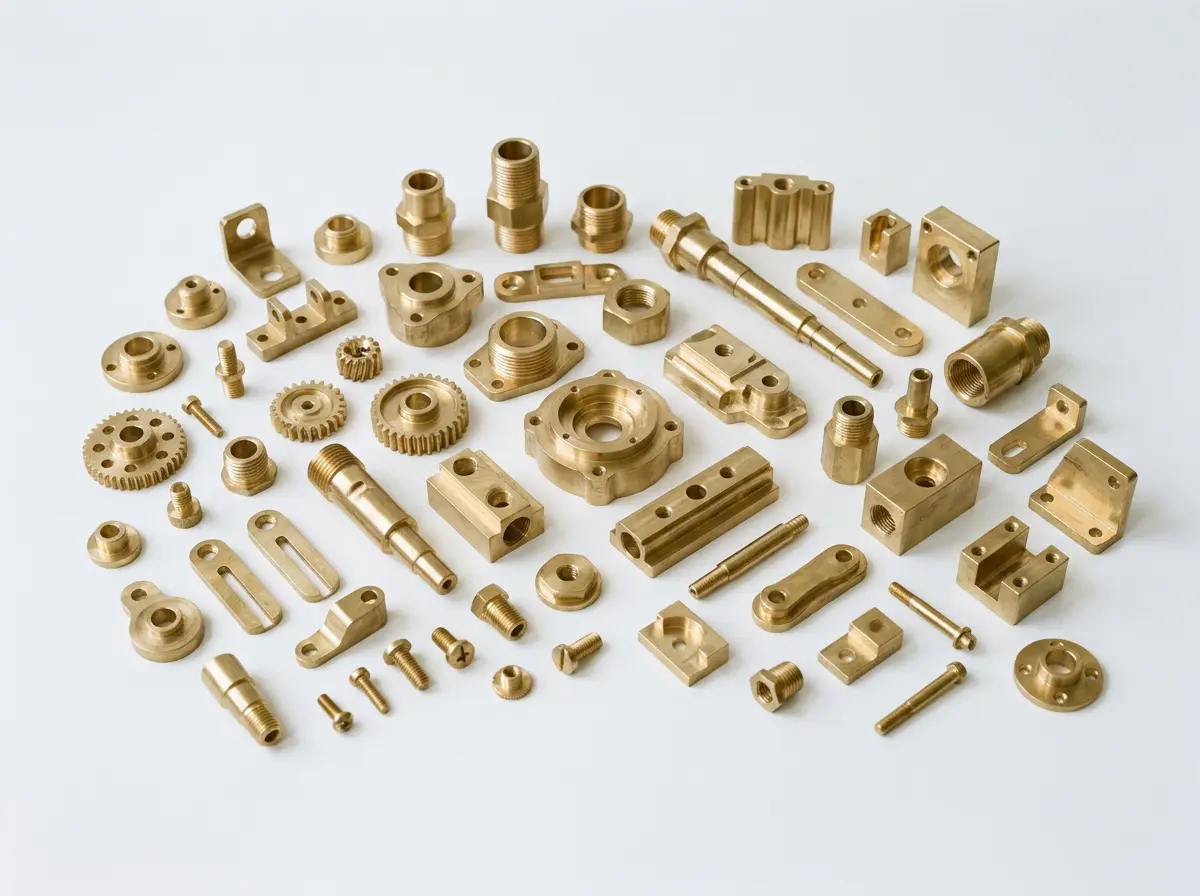
Brass is a copper–zinc alloy family with one of the highest machinability ratings of any engineering metal. It cuts cleanly, holds tight tolerances and produces excellent surface finishes without the tool wear or cycle time penalties common with steels. CNC-machined brass is used across fluid handling, electrical hardware and precision mechanical assemblies — wherever a combination of corrosion resistance, conductivity and reliable dimensional accuracy is needed. Clarwe machines brass in C260 and C360 grades, with CZ121 available for European-specification projects.
Brass at a Glance
| Common grades | C260 (cartridge brass), C360 (free-cutting brass), CZ121 / C38500 |
| Machinability index | 100 (C360) — highest of common engineering metals |
| Standard tolerance | ±0.05 mm |
| Tight tolerance | ±0.02–0.025 mm |
| Minimum wall thickness | 0.8 mm (standard), 0.5 mm (feasible) |
| Surface roughness (Ra) | 0.4–3.2 μm depending on process and finish requirement |
| Typical lead time | 1-4 days |
| Certifications | ISO 9001:2015 · ISO 13485:2016 · AS9100D |
| Best for | Plumbing and fluid systems, electrical hardware, precision mechanical parts |
|
Ready to machine brass parts? Clarwe holds ±0.02 mm on C360 and CZ121 with 1–4 day lead times. |
What Makes Brass a Strong CNC Machining Material
Brass behaves predictably under cutting across both milling and turning operations. Tool life is long, chip formation is controlled and surface finish quality is consistent — advantages that translate directly into shorter cycle times, lower scrap rates and repeatable results across production batches. Tight tolerances that would be challenging in cast or formed materials are routinely achievable in brass.
Key Advantages of Machining Brass
-
Exceptional machinability.Brass C360 carries a machinability index of 100 — the benchmark against which all other metals are measured. Cycle times are fast and tool wear is low.
-
Corrosion resistance without coatings.The right brass alloy resists water-based media, mild chemicals and outdoor environments in as-machined condition, without requiring additional surface treatment.
-
Electrical and thermal conductivity.Brass provides reliable conductivity for connectors, terminals and RF components, combined with the mechanical strength to withstand cycling and assembly loads.
-
Low friction and good wear behaviour.Brass is a natural choice for bushings, bearings and small gears where contact surfaces need to perform over long service intervals.
-
Excellent finishing response.Brass accepts polishing, brushing, plating and coating cleanly, making it well suited to customer-facing components where appearance matters alongside function.
How Brass Compares to Aluminum, Steel and Stainless Steel
| Brass | Aluminum | Mild Steel | Stainless Steel | |
|---|---|---|---|---|
| Machinability | Excellent (index 100) | Very good | Good | Moderate |
| Corrosion resistance | Good (alloy-dependent) | Good | Poor (needs coating) | Excellent |
| Electrical conductivity | Good | Moderate | Low | Low |
| Density | Higher than aluminum | Low | High | High |
| Typical use case | Fluid, electrical, mechanical | Structural, lightweight | Load-bearing, low-cost | Harsh environments |
|
Clarwe machines brass, aluminum, stainless steel and titanium — all to ISO 9001 standard. Compare materials and get a DFM review before committing. Reviewed by a Clarwe engineer within 24 hours. No obligation. |
Brass Alloy Grades for CNC Machining
Clarwe supports three brass grades that cover the most common engineering, electrical and regulatory requirements. Each grade has a distinct balance of machinability, corrosion resistance, strength and compliance characteristics. Choosing the right grade at the design stage avoids substitutions during production and ensures the part performs as intended in its application environment.
Brass C260 (Cartridge Brass) — Properties and Applications
Overview
Brass C260, also known as cartridge brass, is a 70% copper / 30% zinc alloy. It is one of the most widely specified brasses for parts that need a balance of strength, corrosion resistance and cold formability. C260 is not the fastest brass to machine — that distinction belongs to C360 — but it machines cleanly and is the preferred grade when higher ductility or superior corrosion resistance is the priority over cycle time.
Mechanical and Physical Properties
| Property | Typical Value |
|---|---|
| Density | ~8.5 g/cm³ |
| Yield strength | 140–310 MPa |
| Tensile strength | 300–520 MPa |
| Elongation at break | 10–60% |
| Hardness | 60–85 HBW |
| Fatigue strength | 110–160 MPa |
| Machinability index | ~60–70 |
| Electrical conductivity | ~28% IACS |
When to Specify C260
-
Parts exposed to water, humidity or mild corrosive media where C360's lead content is acceptable but better corrosion resistance than C360 is needed
-
Components requiring cold forming or drawing alongside machined features
-
Decorative or cosmetic parts where a polished or plated finish is required and the base material's surface quality matters
-
Electrical contacts and springs where higher ductility is needed to withstand deflection cycles
Common Part Examples
Valve bodies, cartridge housings, decorative fittings, electrical contacts, spring-loaded mechanisms, heat exchanger components.
Brass C360 (Free-Cutting Brass) — Properties and Applications
Overview
Brass C360 is the benchmark free-cutting brass and the most widely machined brass alloy in CNC production. Its machinability index of 100 — the highest of any standard engineering metal — makes it the default choice when throughput, tool life and surface finish consistency are the primary drivers. C360 contains a small addition of lead (approximately 2.5–3.5%) that acts as a chip-breaker, producing short, well-controlled chips and extremely clean machined surfaces.
C360 is the grade to specify for most general-purpose CNC brass work unless the application has specific lead restrictions (regulatory, environmental or potable water contact), in which case CZ121 lead-free variants or C260 should be evaluated.
Mechanical and Physical Properties
| Property | Typical Value |
|---|---|
| Density | 8.45–8.55 g/cm³ |
| Yield strength | 150–300 MPa |
| Tensile strength | 340–470 MPa |
| Elongation at break | 10–30% |
| Hardness | 80–110 HBW |
| Fatigue strength | 80–120 MPa |
| Machinability index | 100 (reference standard) |
| Electrical conductivity | ~26% IACS |
When to Specify C360
-
High-volume or complex parts where fast cycle times and consistent surface finish are the priority
-
Threaded components — C360 produces clean, accurate threads with minimal post-processing
-
Parts with multiple machined features, tight tolerances or fine surface finish requirements
-
Prototype and production runs where lead time and cost efficiency matter
-
Applications where lead content is not restricted by regulation or end-use requirements
Common Part Examples
Fittings and couplings, valve stems and seats, terminal blocks, bushings, precision instrument housings, gears, sensor bodies, RF connectors.
Brass CZ121 / C38500 (CuZn39Pb3) — Properties and Applications
Overview
CZ121 is the European designation for a leaded brass alloy equivalent in composition to C38500 in the US system, with the chemical designation CuZn39Pb3. It contains approximately 39% zinc and up to 3% lead, and is the most commonly specified free-cutting brass in European engineering and manufacturing standards. CZ121 is functionally similar to C360 in machinability and mechanical performance, but is the grade typically called out in EU technical drawings, material certificates and procurement specifications.
If you are supplying parts to European customers or working from EU-origin design documentation, specifying CZ121 / C38500 by name ensures traceability and avoids grade ambiguity during inspection or certification.
Mechanical and Physical Properties
| Property | Typical Value |
|---|---|
| Density | ~8.5 g/cm³ |
| Yield strength | 140–280 MPa |
| Tensile strength | 340–460 MPa |
| Elongation at break | 10–30% |
| Hardness | 75–110 HBW |
| Fatigue strength | 80–120 MPa |
| Machinability index | ~90–100 |
| Electrical conductivity | ~25–27% IACS |
When to Specify CZ121 / C38500
-
Parts destined for European customers, supply chains or assemblies where EU material certification is required
-
Projects where drawings specify CZ121, CuZn39Pb3, 2.0401 or C38500 by designation
-
Applications requiring the same free-cutting performance as C360 but with EU-standard traceability documentation
-
Automotive, fluid handling and industrial components manufactured to European DIN or EN standards
Common Part Examples
Hydraulic fittings and adaptors, automotive fluid system components, instrumentation hardware, industrial valve internals, threaded fasteners and inserts.
|
Not sure which brass grade fits your project? Clarwe engineers review C260, C360 and CZ121 applications daily — including lead content, RoHS constraints, EU certification and potable water compliance. Share your design and we'll confirm the right grade before production starts. Upload Your Design for a Grade & DFM Review → Reviewed within 24 hours. No obligation. |
Design Guidelines for CNC-Machined Brass Parts
Brass's high machinability allows complex geometries and fine features, but staying within the guidelines below keeps parts manufacturable and economical. Use these values as a starting point; Clarwe can review specific geometries that push beyond standard limits.
Wall Thickness, Hole Depth and Fillet Recommendations
| Design aspect | Standard | Feasible minimum |
|---|---|---|
| Wall thickness | 0.8 mm | 0.5 mm |
| Wall height-to-thickness ratio | Up to 8:1 | - |
| Minimum hole diameter | 1.0 mm | 0.5 mm |
| Hole depth (through) | ≤ 8× diameter | - |
| Hole depth (blind) | ≤ 4× diameter | - |
| Minimum fillet radius | 0.5 mm | 0.25 mm |
For walls thinner than 0.8 mm or holes deeper than the standard depth ratios, contact Clarwe before finalising the design — small adjustments at the CAD stage can avoid significant cost increases in production.
Tolerances and Surface Finish Achievable in Brass
| Specification | Value |
|---|---|
| Standard dimensional tolerance | ±0.05 mm |
| Tight tolerance | ±0.02–0.025 mm |
| Surface roughness — milling (standard) | Ra 1.6–3.2 μm |
| Surface roughness — turning (standard) | Ra 0.8–1.6 μm |
| Fine surface finish | Ra 0.4–0.8 μm |
| Maximum for stressed mating surfaces | Ra 3.2 μm |
Where coatings or platings are applied after machining, tolerances should be defined relative to the finished part. Some coatings — nickel plating in particular — add measurable thickness and will affect fits and thread engagement if not accounted for at the design stage.
Where CNC-Machined Brass Performs Best
Brass is rarely the only option, but there are three application categories where it consistently outperforms alternatives on the combination of machinability, corrosion resistance and functional properties.
Brass for Fluid and Plumbing Systems
Brass resists water-based and mildly corrosive media in as-machined condition and can be machined to sealing-critical tolerances that cast or formed alternatives rarely achieve reliably.
Typical parts:valve bodies and stems, pipe and compression fittings, hose connectors, flow regulators, water meter housings, coupling bodies.
Grade recommendation:C360 for standard water service; specify lead-free CZ121 where potable water contact or regulatory compliance (NSF/ANSI 61, WRAS) is required.
Brass for Electrical and Electronic Components
The combination of good electrical conductivity (~26–28% IACS), mechanical strength and excellent machinability makes brass the default choice for precision electrical hardware that must be machined rather than stamped or cast.
Typical parts:terminals, pins and terminal blocks, battery posts and bus bars, RF connectors and shielding housings, grounding hardware, connector bodies.
Grade recommendation:C260 where higher conductivity or spring behaviour is needed; C360 for standard connector and terminal machining.
Brass for Mechanical and Industrial Parts
When moving or load-bearing parts need low friction, good wear resistance and the ability to be machined to tight tolerances in a single setup, brass is a reliable and cost-effective choice over more difficult-to-machine alternatives.
Typical parts:bushings and plain bearings, small gears and drive elements, instrument housings, sensor bodies, precision mechanical hardware, threaded inserts.
Grade recommendation:C360 for the majority of mechanical applications; C260 where higher ductility is needed for press-fit or interference-fit assemblies.
Surface Finish Options for Brass CNC Parts
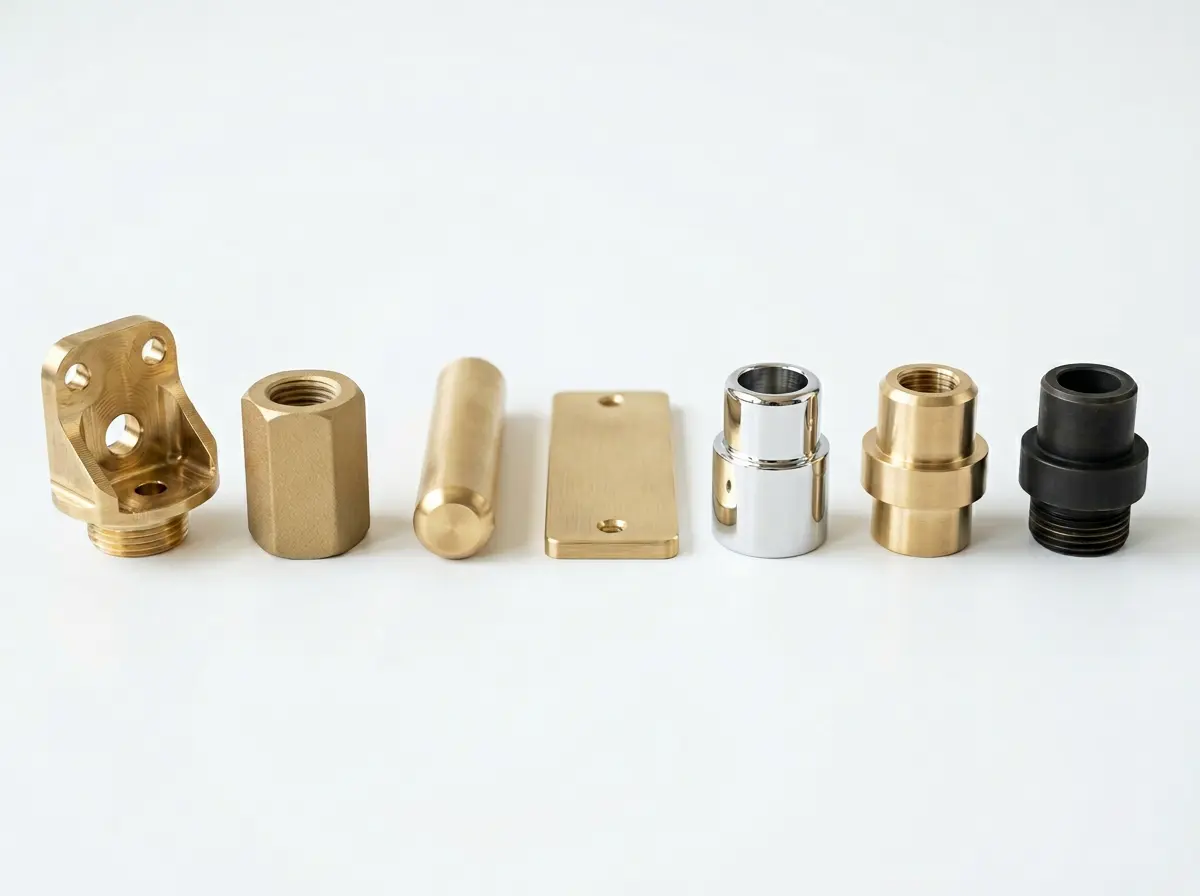
Brass accepts a wider range of finishes than most engineering metals. The right choice depends on whether the part needs functional protection, cosmetic quality, or both.
Standard Finishes: As-Machined and Polished
| Finish | Result | Typical use |
|---|---|---|
| As-machined, deburred | Clean functional surface, tool marks visible, sharp edges removed | Internal components, prototypes, non-visible parts |
| Polished (mechanical) | Smooth, reflective surface, tool marks removed | Customer-facing parts, decorative hardware |
| Brushed | Uniform directional texture, satin appearance | Panels, enclosures, architectural hardware |
As-machined is the default and most cost-effective option. Specify polished or brushed only where surface appearance or reduced friction at contact surfaces is a functional requirement.
Protective and Decorative Coatings for Brass
| Coating | Function | Notes |
|---|---|---|
| Nickel plating | Improved wear and corrosion resistance, bright finish | Adds ~5–25 μm; account for in tolerance-critical fits |
| Chrome plating | Hard, durable surface with high reflectivity | Harder than nickel; used for wear-critical surfaces |
| Gold plating | Maximum conductivity, corrosion resistance, premium appearance | Contacts, connectors, visible electrical hardware |
| Silver plating | High conductivity, solderable surface | RF components, high-frequency connectors |
| Clear lacquer | Slows tarnishing, preserves natural brass colour | Decorative parts, display components |
| Powder coating | Durable colour, impact and chemical resistance | Enclosures, housings, structural hardware |
For parts with tight tolerances or threaded features, confirm whether dimensions apply before or after coating. Plating thickness must be factored into final fit and thread engagement.
|
Need nickel-plated or gold-plated brass parts? Clarwe coordinates plating with machining so your tolerances account for coating thickness from the start. |
Frequently Asked Questions: Brass CNC Machining
What is the machinability rating of brass C360?
Brass C360 has a machinability index of 100 — the highest of any standard engineering metal and the benchmark against which all other metals are rated. This means faster cycle times, longer tool life and more consistent surface finish compared with most steels and aluminium alloys. C260 rates approximately 60–70 and CZ121 approximately 90–100 on the same scale.
What is the difference between C260 and C360 brass?
C260 (cartridge brass, 70% copper / 30% zinc) offers better corrosion resistance and higher ductility, making it suitable for parts that require cold forming alongside machining or that operate in more corrosive environments. C360 (free-cutting brass) contains a small lead addition that gives it a machinability index of 100 — making it faster to machine and better for complex, high-volume or tight-tolerance parts. If lead content is not restricted by regulation, C360 is the default for most CNC work.
What tolerances can be achieved with CNC-machined brass?
Standard CNC machining of brass achieves ±0.05 mm. Tight tolerances of ±0.02–0.025 mm are achievable on suitable features. Where platings or coatings are applied after machining, tolerances should be specified relative to the finished part, as coatings such as nickel plating add measurable thickness.
Is brass RoHS compliant for use in electrical components?
Brass C360 and CZ121 contain lead, which is a regulated substance under RoHS (Restriction of Hazardous Substances) directives in the EU. Leaded brass alloys may qualify under specific RoHS exemptions for certain electrical and electronic applications — exemption categories depend on the application type and should be confirmed with your compliance team. Where RoHS compliance without exemption is required, specify a lead-free brass grade. Contact Clarwe to discuss lead-free options for your project.
Can Clarwe machine lead-free brass for drinking water or food-contact applications?
Yes. Where potable water contact, NSF/ANSI 61, WRAS approval or food-grade compliance is required, Clarwe can advise on and supply lead-free brass grades appropriate for the application. Share your regulatory requirements when submitting your design and we will confirm grade suitability before production.
| Upload your CAD file and Clarwe will review the geometry for manufacturability and provide pricing for CNC-machined brass parts in C260, C360 or CZ121. |