
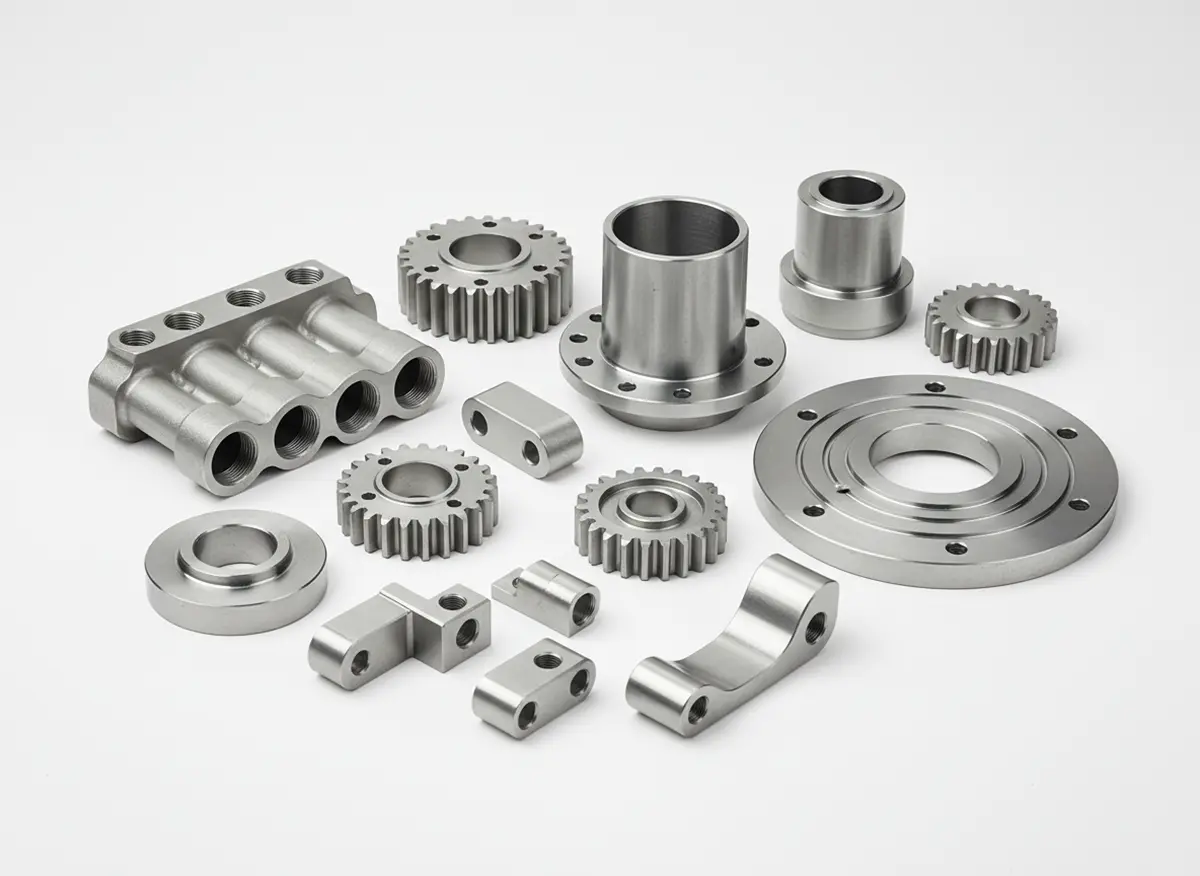
Mild steel is the most widely machined metal in CNC production — chosen by engineers across automotive, industrial equipment, and structural fabrication for its reliable strength, excellent machinability, and low material cost. With carbon content below 0.25%, grades like 1018, 1045 and A36 machine cleanly, weld easily, and hold consistent tolerances across both prototype and production volumes.
At Clarwe, mild steel parts are precision-machined to tight tolerances with full DFM feedback included on every job. Whether you need a single prototype bracket or a production run of precision shafts, our ISO 9001:2015 and AS9100D certified process ensures dimensional accuracy and part-to-part consistency from day one.
| Tolerances to ±0.1 mm Standard; ±0.025 mm precision | Grades: 1018 · 1045 · A36 + European equivalents available | Lead time from 5 days Prototype to production | ISO 9001:2015 · AS9100D Certified manufacturing |
|
Ready to machine your mild steel parts? |
What is Mild Steel?
Mild steel is a low-carbon iron alloy containing between 0.05% and 0.25% carbon by weight — low enough to preserve excellent ductility, weldability and machinability, yet sufficient to deliver the tensile strength needed for structural and mechanical components. It is the most widely used category of steel in the world, spanning industries from automotive and construction to general industrial equipment.
The term "mild steel" covers a family of related grades rather than a single composition. What they share is a carbon content that sits below the threshold at which steels become meaningfully hardenable by heat treatment alone — this is what distinguishes mild steel from medium-carbon and high-carbon steels, and why it behaves the way it does under cutting tools, welding arcs, and forming operations.
For CNC machining specifically, mild steel's low carbon content is an advantage: it produces predictable chip formation, allows high cutting speeds relative to alloy steels, and supports a broad range of surface finishes and post-process coatings — making it a practical default choice for brackets, shafts, fixtures, structural components and general-purpose machined parts across almost every industry.
Mild Steel Composition and Carbon Content
All mild steels are iron-based alloys, with iron typically making up more than 98% of the total composition. Carbon is the primary alloying element, and its concentration within the 0.05–0.25% range has the largest single influence on the steel's mechanical behaviour. Below approximately 0.20% carbon, the steel is at its most ductile and weldable; toward the upper end of the mild range, around 0.20–0.25%, strength and hardness begin to increase at a modest cost to formability.
Manganese is present in most mild steel grades at levels up to around 1.5%. It contributes to strength and hardenability, refines grain structure, and binds with any sulphur present to prevent hot-shortness during welding. Phosphorus and sulphur are controlled as residual elements — kept intentionally low to preserve toughness and weldability. In free-machining variants (such as resulfurised grades), sulphur is deliberately elevated to improve chip-breaking at the cost of some weldability.
| Element | Typical Range | Role in Mild Steel |
|---|---|---|
| Iron (Fe) | > 98% | Base metal — provides structural mass and magnetic properties |
| Carbon (C) | 0.05 – 0.25% | Primary strengthener; kept low to preserve ductility and weldability |
| Manganese (Mn) | 0.30 – 1.50% | Improves strength, grain refinement, and resistance to hot-shortness |
| Phosphorus (P) | < 0.04% | Residual; controlled low to maintain toughness |
| Sulphur (S) | < 0.05% | Residual; controlled low for weldability (resulfurised grades) |
Understanding the composition is practical, not just academic. When specifying a mild steel grade for CNC machining, the carbon level directly affects which cutting parameters are appropriate, how the part responds to any post-machining heat treatment, and which welding procedures can be used during assembly. If your design involves any downstream welding or heat treatment, share that with our engineering team when uploading your drawing — it affects grade selection before a single tool path is programmed.
Mild Steel Grades Available for CNC Machining
Not all mild steels behave identically in the machine shop. Carbon content, manganese levels, and whether the steel is hot-rolled or cold-drawn all affect how a grade machines, what tolerances it can hold, and how it performs in service. The three grades Clarwe machines most frequently — 1018, 1045 and A36 — each occupy a distinct position on the strength-versus-machinability spectrum. Choosing the right one from the outset avoids unnecessary cost and re-work.
Mild Steel 1018 — Best for General-Purpose Machined Parts
Mild steel 1018 is a cold-drawn, low-carbon grade with a carbon content of approximately 0.15–0.20%. Its combination of high machinability, good weldability and consistent dimensional tolerances makes it the default choice for a wide range of CNC-machined components where moderate strength is sufficient and surface quality matters. The cold-drawing process gives 1018 a cleaner surface and tighter dimensional consistency than hot-rolled grades, which is why it is preferred for shafts, pins, studs, bushings and precision fixtures where close tolerances are specified without post-machining grinding.
1018 has a machinability rating of approximately 70% relative to AISI 1212 (the 100% baseline) — meaning it machines efficiently with good chip control, acceptable tool life and smooth surface finishes. It is not the fastest-cutting mild steel, but it is the most predictable, which is the more important quality in a production environment.
Key properties:
-
Carbon content: ~0.15–0.20%
-
Machinability rating: ~70% (AISI 1212 = 100%)
-
Condition: Cold-drawn
-
Weldability: Excellent — suitable for MIG, TIG and resistance welding
-
Hardenability: Low; surface hardening possible via carburising or case hardening
-
Corrosion resistance: Low — protective finish required for most environments
-
Typical applications: Shafts, pins, bushings, dowels, fixtures, brackets, fasteners, general structural parts
Mild Steel 1045 — Higher Strength for Loaded Components
Mild steel 1045 sits at the upper end of the mild/medium-carbon boundary, with a carbon content of approximately 0.43–0.50%. This higher carbon level delivers meaningfully greater tensile and yield strength than 1018, along with improved wear resistance and hardness — making 1045 the preferred choice when a part will be subjected to dynamic loads, impact or surface contact stress that would quickly degrade a lower-carbon grade.
The trade-off is machinability. 1045 is harder to cut than 1018, generates more tool wear, and requires somewhat lower cutting speeds and feeds to maintain surface finish quality. It is also more demanding to weld — preheat is typically required for sections above approximately 19 mm to avoid cracking in the heat-affected zone. For CNC machining purposes, these are manageable constraints, not prohibitive ones — 1045 remains a very common production material. The key is specifying it only where the higher strength is actually needed, rather than defaulting to it across all parts.
1045 responds well to heat treatment. In the normalised condition it offers a useful balance of strength and toughness; quenching and tempering can push yield strength significantly higher for applications such as axles, couplings and heavily loaded machine elements.
Key properties:
-
Carbon content: ~0.43–0.50%
-
Machinability rating: ~57% (approximate relative to AISI 1212)
-
Condition: Hot-rolled or cold-drawn; normalised or Q&T available
-
Weldability: Moderate — preheat recommended for heavier sections
-
Hardenability: Moderate; responds well to quench and temper
-
Corrosion resistance: Low — protective finish required
-
Typical applications: Axles, couplings, gears, sprockets, connecting rods, shafts under high load, bolts and studs requiring greater strength
Mild Steel A36 — Structural Grade for Frames and Brackets
A36 is an ASTM-specification hot-rolled structural steel — the most widely used structural grade in North America — specified primarily by its minimum yield strength of 250 MPa (36 ksi, hence the designation) rather than by a precise chemical composition. Its carbon content typically falls between 0.25% and 0.29%, placing it at the upper boundary of what is generally classified as mild steel. A36 is available in a wide range of product forms: plate, bar, angle, channel and wide-flange sections — which makes it the natural choice when a part transitions between machined features and welded structural elements in the same assembly.
For CNC machining, A36 is serviceable but not ideal as a precision-machined component in isolation. Its hot-rolled condition means surface scale must be removed before machining, dimensional tolerances on the raw stock are wider than cold-drawn grades, and its machinability is slightly lower than 1018. Where A36 genuinely excels is in parts that prioritise structural integrity over tight tolerances — mounting plates, support frames, weld-on brackets, baseplates and structural tabs where the design calls for good weldability across large sections at the lowest possible material cost.
Key properties:
-
Carbon content: ~0.25–0.29% (varies by product form)
- Machinability rating: ~ 50–55% (hot-rolled condition)
-
Specification: ASTM A36
-
Condition: Hot-rolled
-
Weldability: Excellent — preferred for welded structural fabrications
-
Hardenability: Low
-
Corrosion resistance: Low — protective finish required
-
Typical applications: Structural frames, mounting plates, brackets, support structures, baseplates, weld fabrications, general structural components
International Grade Equivalents — C45, EN8, S235JR, S355J2
Mild steel grades are specified differently across national and international standards. If your design uses a European, British or ISO designation — or if you are sourcing parts for an assembly that mixes components from multiple regions — the table below maps the most common equivalent grades to their North American AISI/ASTM counterparts.
| AISI / ASTM (US) | EN / DIN (Europe) | BS (UK) | ISO | Closest JIS (Japan) | Notes |
|---|---|---|---|---|---|
| 1018 | C18 / 1.1141 | 040A18 | C18E | S20C | Cold-drawn; low-carbon general-purpose |
| 1045 | C45 / 1.0503 | EN8 / 080M46 | C45E | S45C | Medium-carbon; strength and wear |
| A36 | S235JR / 1.0038 | S235JR | Fe 360 B | SS400 | Structural grade; specification by yield strength |
| — | S355J2 / 1.0577 | S355J2 | Fe 510 D | — | Higher-strength structural grade; no direct AISI equivalent |
| — | S275JR / 1.0044 | S275JR | Fe 430 B | — | Intermediate structural grade; between A36 and S355 in strength |
Note: Fe 360 B / Fe 510 D are legacy ISO 630 designations; current ISO 630-2 aligns with EN designations shown.
If your drawing references a grade not listed here, share it with our engineering team when uploading your file. We will confirm the equivalent grade we machine and flag any performance differences relevant to your application before quoting. Specifying by the wrong national equivalent — particularly for S355J2 versus A36, which differ meaningfully in yield strength — can affect structural performance and should always be verified before production begins.
|
Know which grade you need? Upload your drawing and our engineering team will confirm grade suitability, flag any DFM issues, and return a quote within 2 hours. |
Mechanical Properties of Mild Steel Grades
While exact values depend on grade, product form and heat treatment, the three grades covered here range from 250 MPa minimum yield (A36 structural) to over 580 MPa in the quenched and tempered condition (1045). Elongation at break values of 12–25% across the three grades indicate meaningful plastic deformation before fracture — a useful characteristic for safety-critical components.
| Material | Density (g/cm³) | Yield Strength (MPa) | Tensile Strength (MPa) | Elongation at Break (%) | Hardness (Brinell) (HBW) | Fatigue Strength (MPa) |
|---|---|---|---|---|---|---|
| Mild Steel 1018 | ∼ 7.85 | 370 - 400 | 440 - 480 | 15 - 25 | 120 - 170 | 200 - 250 |
| Mild Steel 1045 | 7.8 - 7.9 | 330 - 580 | 620 - 680 | 12 - 16 | 190 - 260 | 270 - 320 |
| Mild Steel A36 | ∼ 7.85 | 250 - 350 | 400 - 550 | 18 - 25 | 120 - 180 | 150 - 200 |
| Not sure which grade meets your load and tolerance requirements? Share your drawing with our engineering team — we'll review your design and recommend the right grade before you commit to an order. |
Advantages and Limitations of Mild Steel for CNC Machining
The properties table above shows what mild steel grades can achieve numerically. What it cannot show is when mild steel is the right choice and when it is not. The section below addresses both — so you can make a confident material decision before uploading your drawing.
Why Engineers Choose Mild Steel for Machined Parts
Mild steel's dominance in CNC production volumes comes down to three compounding advantages that no single competing material replicates across all three simultaneously: It is cheap to buy, fast to machine, and straightforward to weld.
Raw material cost is the most visible advantage. Mild steel bar and plate stock costs significantly less per kilogram than stainless steel, alloy steel, titanium or most aluminium alloys in equivalent structural sections. For production volumes where material cost is a meaningful line item, this difference is not marginal.
Machinability compounds that cost advantage. Low-carbon grades — particularly 1018 cold-drawn — produce clean chips, maintain consistent surface finishes across long runs, and cause relatively low tool wear. The result is shorter cycle times and fewer tool changes compared to harder or more abrasive materials, which reduces the machining cost per part beyond the raw material saving alone.
Weldability extends the advantage into the assembly stage. Because 1018 and A36 weld with standard MIG and TIG processes — no specialist filler, no mandatory preheat at standard section sizes — the downstream fabrication workflow stays simple and cost-controlled.
| Advantage | Why It Matters |
|---|---|
| Low raw material cost | Significantly cheaper than alloy steel, stainless steel and most aluminium per structural section |
| High machinability | Short cycle times, long tool life, consistent surface finish — lower cost per part |
| Excellent weldability (1018, A36) | MIG/TIG compatible without preheat at standard sections; no specialist filler required |
| Good formability | Tolerates bending, pressing and cold forming without cracking |
| Broad stock availability | Standard grades stocked globally in bar, plate, tube and sheet — no raw material lead time risk |
| Wide finishing compatibility | Accepts powder coat, zinc plating, electroless nickel, black oxide and paint without adhesion complications |
| Predictable batch consistency | Well-documented mechanical properties with low batch-to-batch variation |
Limitations to Plan Around Before Specifying
Mild steel has three genuine limitations. They are manageable — but only if they are designed for from the outset rather than discovered after a part fails or a drawing is rejected.
Corrosion. Mild steel has no inherent corrosion resistance — unprotected, it will rust in the presence of moisture and oxygen. A surface finish is a functional requirement for any part used outside a dry, controlled environment. Specify the finish before quoting — coating thickness affects machined pre-coat dimensions, and changing a finish specification after machining can require re-work. See the Available Surface Finishes section below for options.
Hardenability ceiling. Low-carbon mild steels cannot be through-hardened by heat treatment in the way alloy steels can. 1018 can be surface-hardened by carburising to a shallow case depth; 1045 responds to quench-and-temper but is bounded by its carbon content. If the application requires through-hardness above approximately 40 HRC, high contact-stress fatigue resistance, or sustained elevated-temperature performance, alloy steel — 4140 or 4340 — will serve the application better than any mild steel variant.
Density. At approximately 7.85 g/cm³, mild steel is roughly 2.9× denser than aluminium 6061. For weight-sensitive designs — portable equipment, handheld tools, aerospace brackets — check whether aluminium provides adequate strength at the required wall thickness before defaulting to steel. Where it does, the weight saving is almost always worth the higher material and machining cost.
| Limitation | Design Response |
|---|---|
| Corrodes without surface protection | Specify finish at drawing stage; allow for coating thickness on critical dimensions |
| Not through-hardenable by heat treatment | Use 1045 + case hardening for surface wear; specify 4140 alloy steel if through-hardness is required |
| Denser than aluminium (~7.85 g/cm³) | Evaluate aluminium for weight-constrained applications before specifying mild steel |
| Hot-rolled grades carry wider raw stock tolerances | Specify cold-drawn grades (e.g., 1018 CD) where pre-machining dimensional consistency is required |
How to Choose Between 1018, 1045 and A36
Each of the three grades occupies a distinct position on the machinability-strength curve. The decision is not complicated, but the consequences of the wrong choice are — a part machined in A36 that should have been 1018 will cost more to hold tolerance on; a shaft specified in 1018 that should have been 1045 will fail under load. The following section removes that ambiguity.
Grade Selection Quick-Reference Guide
Use the table as a first-pass filter. If more than one grade appears to fit, default to the one with higher machinability — it will be less expensive to produce and easier to weld at the assembly stage.
| Design Requirement | Recommended Grade | Reason |
|---|---|---|
| General-purpose parts — shafts, pins, bushings, brackets | 1018 | Highest machinability of the three; cold-drawn stock holds tighter pre-machining tolerances |
| Tight dimensional tolerances without post-machining grinding | 1018 | Cold-drawn condition provides cleaner surface and consistent diameter vs. hot-rolled grades |
| Parts welded into an assembly at standard section sizes | 1018 or A36 | Both weld without preheat; no specialist filler required |
| Higher tensile strength under static load | 1045 | Higher carbon raises yield and tensile strength significantly above 1018 |
| Components under cyclic, dynamic or impact loading | 1045 | Better fatigue and impact resistance; refer to the properties table above for comparative values |
| Heat treatment required after machining (Q&T or case hardening) | 1045 | Sufficient carbon to respond meaningfully to normalising and quench-and-temper |
| Structural frames, mounting plates and welded fabrications | A36 | Hot-rolled structural grade; excellent weldability across large sections at lowest material cost |
| Tightest possible material cost on structural parts | A36 | Widest global availability and lowest price per kg of the three grades |
| First-article prototype with undecided production grade | 1018 | Easiest to machine, lowest scrap risk, most forgiving for initial design validation |
Which Grade is Best for Your Application?
Shafts, pins and precision fixtures
Specify 1018 cold-drawn. The cold-drawing process produces tight diameter tolerances and a clean surface that frequently eliminates a post-machining grinding operation — reducing both lead time and cost. Reserve 1018 for parts where moderate tensile strength is sufficient. For shafts under high cyclic stress — rotating equipment, drivetrain components, couplings — the fatigue performance of 1018 (200–250 MPa, per the properties table above) may be insufficient and 1045 normalised or Q&T should be evaluated.
Structural brackets, frames and mounting plates
Specify A36. Its minimum yield of 250 MPa covers the majority of structural load cases at the lowest possible material cost, and it welds reliably across large sections without process complications. The one exception: if the same part also requires precision-machined mating faces, bolt circle tolerances or close-fit bores, consider switching to 1018 — A36's hot-rolled condition and wider compositional tolerances produce less consistent results on tight-tolerance features than cold-drawn 1018.
Gears, axles, couplings and load-bearing machine elements
Specify 1045. Higher contact stress, impact loading and fatigue demand the greater strength and hardness capability that 1045 provides — particularly in the Q&T condition where yield strength can reach 580 MPa and tensile strength exceeds the normalised range shown in the properties table above. If the application demands more than Q&T 1045 can deliver — very high cycle fatigue, extreme contact stress, or operating temperatures above approximately 300 °C — evaluate 4140 alloy steel before finalising the specification.
Fixtures, jigs and workholding components
Specify 1018 cold-drawn. Fixture performance depends primarily on machined dimensional accuracy, not raw material strength — which makes 1018 the correct choice for drill jigs, assembly fixtures, vee-blocks and checking gauges. Where a specific locating feature needs surface hardness, case hardening of that single feature is straightforward on 1018 without hardening the entire component and introducing distortion risk.
When None of the Three Grades Is the Right Answer
If the requirement includes any of the following, raise it with our engineering team before selecting a mild steel grade — a different material family will serve the application better:
-
Corrosion resistance without a surface coating → Stainless steel 303, 304 or 316
-
Sustained operating temperature above approximately 300 °C → Alloy steel or heat-resistant grade
-
Through-hardness above approximately 40 HRC → 4140 or 4340 alloy steel
-
Food contact, pharmaceutical or sterile environment → Stainless steel 316L
-
Weight-critical design where aluminium provides adequate strength → Aluminium 6061 or 7075
- Low chemical and temperature resistance → Specify stainless steel for food contact, pharmaceutical, high-temperature or sustained wet environments
|
Not Sure Which Grade Fits? Ask Our Engineers — Free, No Commitment Describe your application and we'll recommend the right grade before you finalise your drawing. |
CNC Machining Capabilities for Mild Steel Parts
Knowing a material's properties is only half of what a buyer needs before submitting a drawing. The other half is understanding what the machining process can actually achieve — the tolerances it holds, the finishes it produces, and the practical boundaries on part size and geometry. The figures below reflect Clarwe's standard capabilities for CNC-machined mild steel components.
Tolerances and Dimensional Standards
For most mild steel CNC parts, a standard machined tolerance of ±0.1 mm is achievable across milled and turned features without special process controls. Where drawings call for tighter fits — bearing seats, interference fits, precision bores and mating faces — ±0.025 mm is achievable on specific features with appropriate fixturing and tooling selection.
If your drawing carries GD&T callouts or ISO 2768 tolerance class designations, include them in your upload and our engineering team will confirm achievability at the quoting stage.
| Tolerance Class | Achievable Value | Typical Application |
|---|---|---|
| Standard machined | ±0.1 mm | General features, brackets, structural parts, clearance fits |
| Precision machined | ±0.025 mm | Bearing seats, precision bores, interference fits, mating faces |
| Surface roughness (as-machined) | Ra 1.6 – 3.2 µm | Standard finish from milling and turning operations |
| Surface roughness (fine finish) | Ra 0.8 µm | Specified features; requires additional pass or operation |
| Thread tolerances | 6H / 6g (ISO standard) | Standard internal and external threads unless otherwise specified |
Available Surface Finishes for Mild Steel
Because mild steel corrodes without surface protection, finish selection is a functional decision, not just an aesthetic one. The table below lists the finishes Clarwe applies to mild steel CNC parts, with guidance on corrosion protection level and typical use case for each.
| Surface Finish | Corrosion Protection | Appearance | Best Used For |
|---|---|---|---|
| As-machined | None | Bare metal, tool marks visible | Internal components, parts finished by customer, short-term prototypes |
| Black oxide | Low (requires oil seal) | Matte black | Tooling, fixtures, industrial components where light corrosion resistance is sufficient |
| Zinc electroplating | Moderate | Bright or clear metallic | General engineering parts, fasteners, brackets in mild environments |
| Electroless nickel plating | Good | Uniform silver-grey | Precision parts requiring dimensional consistency across complex geometry |
| Powder coating | Good–Excellent | Wide colour range, textured or smooth | Structural components, machine housings, parts in outdoor or humid environments |
| Paint / primer + topcoat | Good (depends on system) | Wide colour range | Fabricated structures, large plates and frames |
| Hot-dip galvanising | Excellent | Spangled zinc, rough surface | Structural steel for outdoor or marine environments (dimensional tolerance affected) |
For a full listing of available finishes, process details and thickness specifications, see our surface finishes page.
Lead Time and Part Size
Standard lead time for CNC-machined mild steel parts at Clarwe is 5–7 working days from drawing approval, covering both prototypes and low-to-mid volume production runs. Complex multi-operation parts or those requiring post-machining heat treatment or specialist plating may require additional time, which will be confirmed at the quoting stage.
| Parameter | Standard Capability |
|---|---|
| Lead time | 5 working days (from drawing approval) |
| Minimum wall thickness | 0.75 mm |
| Minimum hole diameter | 1.0 mm |
| Maximum milled part size | 2,000 × 800 × 500 mm (indicative; contact for oversized parts) |
| Maximum turned diameter | 500 mm OD (indicative) |
| Batch size | 1 piece to production volumes |
Design Considerations for CNC-Machined Mild Steel Components
Well-designed parts machine faster, hold tolerances more reliably and cost less to produce. The guidelines below flag the most common mild steel design issues that affect machinability, part performance and cost — review them before finalising your drawing.
Wall Thickness, Fillets and Hole Depth Guidelines
Wall thickness — Avoid walls thinner than 0.75 mm on mild steel parts. Thin walls deflect under cutting forces, which makes tolerances difficult to hold and increases the risk of chatter marks on the surface. For structural parts where rigidity matters, 1.5 mm or greater is a safer lower limit.
Internal corners and fillets — All internal corners will carry a radius equal to at least half the diameter of the cutting tool used. Specifying sharp internal corners (zero radius) is not achievable with standard rotating tools and forces the use of EDM or hand-finishing operations, both of which add cost and lead time. Where a sharp corner is genuinely required for a mating part, specify a relief undercut rather than a zero-radius corner. As a practical guide, an internal fillet radius of 1–3 mm on most features is machineable without special tooling and improves fatigue performance by reducing stress concentration.
Hole depth — Through-holes are straightforward. For blind holes, a depth-to-diameter ratio of up to 4:1 is standard with no special consideration; 4:1–6:1 is achievable but may require longer-reach tooling; above 6:1 requires specialist tooling and should be flagged in the drawing notes. Threads in blind holes should allow a minimum of 1.5× diameter of thread engagement and at least 3 thread pitches of unthreaded relief at the bottom of the hole to accommodate the tap run-out.
Tolerances and drawing callouts — Apply tight tolerances only where they are functionally necessary. Every additional tight-tolerance feature adds inspection time and increases the probability of a non-conforming part. Use ISO 2768-m (medium) as the default general tolerance class and apply tighter callouts only to features where fit, function or assembly require it.
Corrosion Protection: Coatings and Plating for Mild Steel Parts
Because mild steel has no inherent corrosion resistance, the coating or finish specified in the drawing is as important as the grade selection itself. Apply these principles when finalising your surface finish specification:
Allow for coating thickness in critical dimensions. Electroplating and electroless nickel add 5–25 µm per surface. Powder coating adds 60–120 µm. If a bore or shaft is dimensionally critical after coating, the machined dimension must account for the coating buildup — specify this explicitly on the drawing or flag it in your upload notes so our team can apply the correct machined pre-coat dimension.
Specify finish before quoting, not after. Changing a finish specification after a part has been machined can require re-machining if the new finish has a different thickness. Agree the finish at drawing review stage.
Match finish to environment. Black oxide with an oil seal is adequate for indoor tooling and fixtures in dry environments. For any external, humid or wash-down environment, powder coating or zinc plating is the minimum. For marine, chemical or sustained wet environments, hot-dip galvanising or a multi-coat paint system should be specified.
For guidance on selecting the right finish for your application, upload your drawing with environment details included in the notes and our engineering team will advise at the DFM review stage.
Mild Steel CNC Machining Applications by Industry
Mild steel's combination of strength, machinability and cost makes it a default material across a broad range of industries. The applications below represent the most common use cases Clarwe produces — each with specific grade and finish recommendations drawn from production experience.
Automotive and Powertrain Components
Mild steel accounts for a significant share of CNC-machined automotive components where weight is not the primary constraint — drivetrain brackets, engine mounts, gearbox housings, shaft collars, flanges and general structural support components. Grade 1018 handles the majority of precision-machined automotive parts; 1045 is specified for higher-load elements such as stub axles, yokes and couplings. Zinc plating or electroless nickel are the most common finishes for under-hood parts requiring moderate corrosion resistance in a heated, occasionally humid environment.
Industrial Equipment and Machinery Parts
Industrial machinery is the single largest market for mild steel CNC parts. Frames, platens, slide components, guide rails, bearing housings, clamping elements and machine bases are routinely machined from A36 (for structural elements) and 1018 (for precision-machined components). Surface finish requirements vary widely — from bare as-machined for internal machine elements to powder-coated for exposed panels and housings. Where a component operates in a wash-down or chemical environment, electroless nickel or zinc plating are specified for corrosion protection without significant dimensional impact.
Structural and Construction Hardware
A36 structural hardware — mounting plates, anchor brackets, support gussets and structural inserts — is a core Clarwe production category. Parts in this category typically carry a small number of precision features (bolt patterns, bearing faces, alignment pins) on a structural form, weld readily into fabricated assemblies, and are finished with paint, powder coat or galvanising to suit the exposure environment.
Fixtures, Jigs and Tooling
Manufacturing fixtures — drill jigs, assembly fixtures, checking gauges, vee-blocks and workholding components — are almost universally machined from 1018 cold-drawn for its dimensional stability, consistent machinability and low material cost. Fixture accuracy depends primarily on the machined dimensions rather than the material's strength, which makes 1018 ideal. Black oxide with an oil seal is the most common finish for tooling components that will be handled frequently and stored in a controlled environment. Where a specific locating feature requires hardness, case hardening of that feature alone is straightforward on 1018.
Frequently Asked Questions
What is the best mild steel grade for CNC machining?
For most CNC-machined parts, 1018 cold-drawn is the best starting point. It has the highest machinability of the common mild steel grades, holds tight tolerances without post-machining grinding, and welds well. Specify 1045 when the part carries significant load, experiences cyclic stress, or requires heat treatment. Specify A36 when the primary requirement is structural integrity and weldability across large sections at minimum material cost.
What is the difference between mild steel and carbon steel?
Mild steel is a sub-category of carbon steel, not a separate material family. The term "carbon steel" covers the full range from low-carbon to high-carbon grades. Mild steel specifically refers to grades with carbon content below approximately 0.25% — the range at which steel remains ductile, readily weldable and easy to machine. Medium-carbon grades like 1045 sit at the boundary of this definition; high-carbon grades above ~0.60% carbon are harder, less weldable and used primarily for tools and springs.
Does mild steel rust, and how do I prevent it on machined parts?
Standard CNC machining of mild steel achieves ±0.1 mm on general features. Precision features — bearing seats, interference fits and critical mating faces — can be held to ±0.025 mm with appropriate fixturing. Standard as-machined surface roughness is Ra 1.6–3.2 µm; fine-finish passes can achieve Ra 0.8 µm on specified features. Apply GD&T callouts or ISO 2768 tolerance classes on your drawing, and our team will confirm achievability at the DFM review stage.
What tolerances can be held on CNC-machined mild steel parts?
Yes — significantly. Mild steel is less expensive than stainless steel both in raw material cost and in machining time. Stainless steel work-hardens during cutting, generates higher cutting forces and causes greater tool wear, all of which increase cycle time and cost per part. For applications where corrosion resistance is not a functional requirement and a surface coating is acceptable, mild steel is the more cost-effective choice. Stainless steel should be specified when the application involves food contact, pharmaceutical environments, sustained wet exposure, or where a coating is not viable.
Can mild steel be welded after CNC machining?
Yes. Mild steel's low carbon content makes it one of the most weldable engineering metals. Grades 1018 and A36 can be MIG or TIG welded at standard section sizes without preheat or specialist filler materials. Grade 1045 requires preheat for sections above approximately 19 mm to prevent cracking in the heat-affected zone. If your machined mild steel part will be welded into a larger assembly, include that information when uploading your drawing — it can influence grade selection and any post-weld heat treatment requirements.
Get a Quote for Your Mild Steel CNC Parts
Clarwe produces CNC-machined mild steel parts in grades 1018, 1045 and A36 to tolerances from ±0.1 mm standard to ±0.025 mm precision — with full DFM feedback included on every job. From single prototypes to production volumes, our ISO 9001:2015 and AS9100D certified process ensures dimensional accuracy and part-to-part consistency from the first piece.