
Bronze is a family of copper alloys distinguished by a combination of properties that few engineering metals deliver together: low sliding friction, high resistance to wear, reliable corrosion resistance in wet and marine environments, and fatigue endurance under sustained dynamic loading. Where steel is too hard on mating surfaces, aluminium too soft for load-bearing wear contact, and brass too weak under high-cycle fatigue, bronze occupies a well-defined performance tier that has made it the default specification for precision bearings, bushings, worm gears and valve components across marine, industrial and power transmission applications.
Clarwe machines bronze in three bearing-grade alloys — C932 high-leaded tin bronze, C544 phosphor bronze and C954 aluminium bronze — covering the full range from cost-effective general-purpose bushings through to high-strength, seawater-resistant structural components. Alloy selection, machining approach and design geometry all interact in bronze more than in most CNC metals: the sections below cover each alloy in detail, provide machining parameters for all three grades, and give bearing-specific design guidelines that reduce scrap and maximise in-service life.
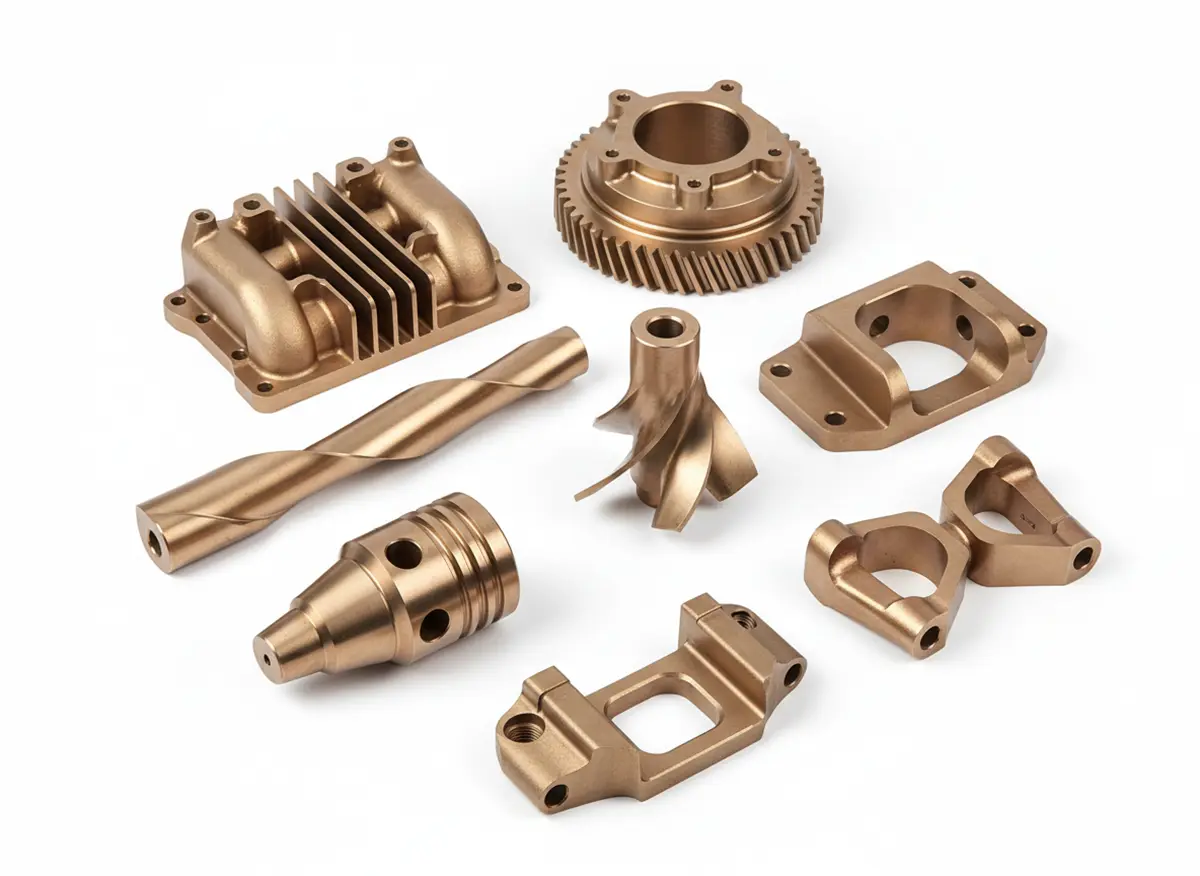
Bronze Alloys for CNC Machining
The three alloys — C932, C544 and C954 — each have a distinct composition optimised for a different performance priority. The properties table below compares all three grades; alloy descriptions and a grade selection guide follow.
| Material | Density (g/cm³) | Yield Strength (MPa) | Tensile Strength (MPa) | Elongation at Break (%) | Hardness (Brinell) HBW | Fatigue Strength (MPa) |
|---|---|---|---|---|---|---|
| C932 High-Leaded Tin Bronze | 8.7–8.9 | 100–140 | 200–260 | 10–20 | 60–80 | 100–120 |
| C544 Phosphor Bronze | 8.8–8.9 | 200–350 | 450–620 | 10–25 | 150–190 | 150–220 |
| C954 Aluminium Bronze | 7.3–7.6 | 230–360 | 550–700 | 8–16 | 160–200 | 110–160 |
C932 — High-Leaded Tin Bronze (General-Purpose Bearing Alloy)
C932 consists of 83% copper, 7% tin and 7% lead. The lead inclusions serve a dual purpose: they act as built-in chip breakers during machining and as a solid-state lubricant during service, releasing progressively under contact pressure to reduce friction at the sliding interface. This makes C932 both the easiest of the three alloys to machine and the most forgiving in marginally lubricated bearing applications.
Its debris embeddability — the ability to absorb hard particles into the soft lead matrix rather than transmit them to the mating shaft — makes it well-suited to environments where contamination cannot be fully excluded. C932 performs reliably across a wide load and speed range without demanding premium tooling or tight process controls.
Standard:SAE 660 / ASTM B505
Machinability:Excellent (100% index)
Stock colour:Natural golden-brown
Best for:General-purpose bushings, thrust washers, low-to-medium load plain bearings, prototype and pre-production bearing runs, cost-driven applications where C544 or C954 strength is not required.
Not suitable for:High-cycle fatigue applications, operating temperatures above 200 °C, or applications subject to RoHS / REACH lead restrictions.
C544 — Phosphor Bronze (High-Fatigue, High-Conductivity)
C544 contains approximately 91% copper, 5% tin, 4% lead and trace phosphorus (0.01–0.35%). The phosphorus refines grain structure and significantly increases resistance to fatigue crack initiation — the defining characteristic that separates C544 from C932 in high-cycle dynamic applications. Tensile strength of 450–620 MPa and fatigue strength of 150–220 MPa place it well above C932 for rotating and oscillating assemblies subject to millions of load cycles.
Lead content — compliance note:C544 is a leaded phosphor bronze. It is not lead-free. For applications subject to RoHS, REACH or food-contact regulations, verify compliance before specifying this grade. Lead-free phosphor bronze (C510 / C511) is available on request — advise at the quoting stage.
Standard:ASTM B139 / B505
Machinability:Good (coated carbide at 800–1,200 SFM recommended)
Stock colour:Golden-yellow
Best for:High-speed bearings requiring 10⁶+ cycle endurance, pump shafts under continuous vibration, electrical connectors and contacts where fatigue resistance and conductivity are both required, valve bodies and precision spring components.
Not suitable for:Lead-sensitive or regulated applications without prior compliance verification; marine seawater immersion (C954 is the correct grade).
C954 — Aluminium Bronze (Maximum Strength and Corrosion Resistance)
C954 contains 85% copper, 11% aluminium and 4% iron/nickel. On exposure to atmosphere or seawater it forms a dense, tightly adherent aluminium oxide layer that provides corrosion protection comparable to stainless steel — significantly outperforming both C932 and C544 in marine, chemical and high-humidity service. At 550–700 MPa tensile strength it is the strongest of the three alloys, capable of carrying structural loads that would yield the leaded bronzes. C954 contains no lead, which simplifies compliance for RoHS and food-contact applications.
The trade-off is machinability: the aluminium oxide layer and higher hardness make C954 more demanding to cut than C932 or C544, with a risk of work hardening during interrupted cuts that requires rigid setups and controlled parameters — see the machining section below. Factor higher machining cost into grade selection where C932 or C544 properties are adequate.
Standard:UNS C95400 / ASTM B505
Machinability:Moderate — rigid fixturing and controlled parameters essential
Stock colour:Dark golden-brown to bronze-grey
Best for:Heavy-duty gears, marine propellers and shaft bearings, industrial valves in corrosive process streams, seawater pump components, aerospace and defence structural fittings requiring maximum strength-to-weight.
Not suitable for:Cost-sensitive high-volume bushing applications where C932 performance is sufficient.
How to Choose Between C932, C544 and C954
Most bronze selection decisions reduce to three questions.
What is the load and duty cycle?
For light-to-medium loads and standard duty cycles, C932 is sufficient and most cost-effective. For high-cycle fatigue applications, C544's superior fatigue strength justifies the premium. For the highest structural loads, C954 is the correct grade.
What is the operating environment?
For standard industrial environments, C932 or C544. For marine environments, seawater contact, chemical process fluids or sustained outdoor exposure, C954 is the only appropriate grade of the three.
Are there regulatory or compliance constraints?
C932 and C544 both contain lead. For RoHS, REACH or food-contact applications, C954 is the compliant default. If lead-free phosphor bronze is required, advise Clarwe at quoting.
| Requirement | C932 | C544 | C954 |
|---|---|---|---|
| General-purpose bushings — lowest cost | ✓ | ||
| High-cycle fatigue (10⁶+ cycles) | ✓ | ||
| Marine / seawater / corrosive environments | ✓ | ||
| Electrical conductivity + fatigue resistance | ✓ | ||
| Lead-free / RoHS compliant | ✓ | ||
| Maximum structural load capacity | ✓ |
Not sure which alloy is right for your application?
Share your design and operating conditions — load, environment, duty cycle and any RoHS or lead-free requirements — and a Clarwe engineer will confirm the correct grade before production starts.
|
Bronze Quick Reference
| C932 | C544 | C954 | |
|---|---|---|---|
| Common name | Bearing bronze / SAE 660 | Phosphor bronze | Aluminium bronze |
| Max service temp. | 200 °C | 260 °C | 400 °C |
| Corrosion resistance | Good | Good | Excellent — seawater rated |
| Lead content | Yes — verify RoHS | Yes — verify RoHS | No — RoHS compliant |
| Machinability | Excellent | Good | Moderate |
| Standard tolerance | ±0.10 mm | ±0.10 mm | ±0.10 mm |
| Tight tolerance | ±0.025 mm | ±0.025 mm | ±0.025 mm |
| Typical lead time | 3–5 days | 3–5 days | 3–7 days |
| Relative cost | $$ | $$$ | $$$ |
| Best for | General bushings, thrust washers, cost-driven bearing runs | High-cycle fatigue, electrical contacts, vibrating shafts | Marine, heavy-duty gears, corrosive environments, structural fittings |
Achievable Tolerances on CNC-Machined Bronze Parts
Bronze's combination of stiffness and machinability allows tight tolerances on small-to-medium parts under controlled conditions. The ranges below apply across all three alloys, with C954 requiring the most attention to achieve tight tolerance consistently due to its work hardening tendency.
| Dimension type | Standard tolerance | Tight tolerance |
|---|---|---|
| Linear dimensions | ±0.10 mm | ±0.025 mm |
| Bore diameter (bushing ID) | ±0.05 mm | ±0.013 mm |
| OD (press-fit housing diameter) | ±0.05 mm | ±0.013 mm |
| Flatness | 0.10 mm / 100 mm | 0.025 mm / 100 mm |
| General unspecified | ISO 2768 medium | - |
For tight-tolerance bearing bores — particularly H7/g6 and interference fits — a two-stage turning approach is recommended: rough bore to within 0.3–0.5 mm of final dimension, allow thermal stabilisation, then finish bore to tolerance. Measuring parts at ambient temperature (not immediately after cutting) is critical for accurate inspection of bore diameters in all three alloys.
Design Rules for CNC-Machined Bronze Bushings and Bearings
Bronze is used almost exclusively for load-bearing, wear-critical and sliding components — the design rules below are written around that reality. They address the geometry decisions that determine whether a bronze bushing or bearing performs reliably in service and machines consistently in production.
Wall Thickness, Bore Fits and Oil Groove Geometry
Minimum wall thickness for a functional bronze bushing is 1.0 mm. Below this, the bushing wall lacks the structural integrity to resist press-fit installation forces and will distort during fitting, shifting the bore out of tolerance. For standard service applications, 1.5–2.5 mm wall thickness is the practical preferred range. Heavy-duty bushings carrying high radial loads benefit from walls of 3.0 mm or more to distribute contact stress across a larger cross-section and reduce deformation under peak load.
| Design feature | Recommendation | Minimum |
|---|---|---|
| Wall thickness | 1.5–2.5 mm (standard) · 3.0 mm+ (heavy duty) | 1.0 mm |
| ID chamfer (assembly lead-in) | 0.8 mm × 45° both ends | 0.5 mm × 45° |
| Oil groove width | 4–6 mm · 50% circumferential coverage | 3 mm |
| Oil groove depth | 0.5–1.0 mm | 0.3 mm |
| Edge relief on thrust faces | 0.5 mm | 0.25 mm |
| OD tolerance (press fit into housing) | h6 or r6 per interference requirement | ±0.025 mm |
| ID tolerance (running fit on shaft) | H7 for rotating · H8 for oscillating | ±0.013 mm |
| Length tolerance | ±0.10 mm standard · ±0.05 mm tight | ±0.05 mm |
| Flatness (thrust washer faces) | 0.05 mm max | 0.025 mm |
| Mating shaft surface finish | Ra 0.8–1.6 µm recommended | Ra 0.4 µm |
Bore fit and press-fit closure: H7/g6 is the standard fit for a pressed bronze bushing into a steel housing. Press-fitting compresses the bushing OD and causes the bore to close inward — for bushings with wall thickness of 1.5–2.5 mm, allow 0.01–0.04 mm bore closure depending on interference level, and finish-bore after installation where tight ID tolerances are required.
Oil groove placement:Circumferential grooves should stop 2–3 mm short of each bushing end face to preserve oil-retaining lands at the ends. Axial distribution grooves should be positioned away from the primary load zone — typically the lower half of the bore for gravity-loaded horizontal shafts.
Thread Design in Bronze
All three bronze alloys machine threads cleanly with standard taps and thread mills. C932 and C544 are straightforward; C954 requires sharper taps and reduced cutting speeds to avoid work hardening at the thread root.
-
Coarse threads(M4 and above) are preferred over fine threads. The larger pitch cross-section improves pull-out strength and reduces stripping risk under installation torque.
-
Thread engagement lengthshould be a minimum of 1.5× the thread diameter. For C932 — the lowest tensile strength of the three alloys — 2× engagement length is recommended at high-torque fastener locations.
-
Threaded inserts(Helicoil or press-fit) are not typically required in bronze. Machined threads in bronze are durable and resist stripping in most engineering applications; inserts are only warranted where hardened or stainless fasteners are assembled and disassembled repeatedly in C932 threaded holes.
-
Allow 0.5–1.0 mm thread run-out clearance at the base of all blind tapped holes to prevent tap bottoming during production.
-
For C954, use spiral-flute taps with lubricant and reduce tapping speed by 30–40% relative to C932 to prevent work hardening at the thread flanks.
Design for Manufacturability: How to Reduce Bronze CNC Machining Cost
Bronze is a premium-cost CNC material relative to aluminium or mild steel. The DFM guidelines below reduce machining time, material consumption and scrap risk without compromising the functional performance of the finished part.
Right-Size the Alloy Grade
C932 is consistently the least expensive of the three alloys to procure and machine — superior machinability (100% index) and lower raw stock cost combine to make it the lowest cost-per-part option wherever its properties are adequate. Only upgrade to C544 if high-cycle fatigue or electrical conductivity are genuine, documented design requirements. Only specify C954 if marine or chemically corrosive service, structural load capacity above C544's range, or lead-free compliance are actual operating conditions. Over-specifying alloy grade — the single most common cost driver in bronze CNC machining — adds material and machining cost with no functional return.
Minimise Thin Walls and Long Unsupported Bores
Wall thickness below 1.5 mm and bore L/D ratios above 4:1 both increase fixturing complexity, cycle time and scrap risk — and should be avoided unless the application demands them. Refer to the design rules section above for geometry guidance. Where a long bore cannot be avoided, splitting into two shorter bushings in tandem reduces machining cost and improves bore straightness.
Apply Tight Tolerances Only Where Function Demands It
±0.10 mm (ISO 2768 medium) is adequate for the majority of external dimensions — flanges, lengths, OD steps and non-mating faces — on bronze bushings and bearing components. Bore diameter (running fit on shaft) and housing OD (press-fit) are the only features that typically require ±0.013–0.025 mm tolerancing. Calling tight tolerances on every feature adds machining passes, inspection time and cost with no functional benefit. Clearly distinguish functional from non-functional dimensions on the drawing to allow the machinist to prioritise effort and reduce per-part cost.
Consolidate Features to Reduce Setups
Each additional setup — a re-fixture, a flip or a secondary clamping position — adds time and introduces datum shift risk. Where design allows, consolidate oil grooves, chamfers, reliefs and counterbores so that all features on a given diameter are completed in the same turning or milling operation. For flanged bushings, designing the flange chamfer and OD chamfer to the same angle (typically 45°) allows both to be cut with the same tool path without a tool change.
Batch Multiple Variants in the Same Alloy
C932, C544 and C954 are each stocked as round bar in standard diameters. When ordering multiple bushing variants in the same alloy grade, consolidating them into a single production run allows Clarwe to minimise material changeover, amortise setup time across a larger batch, and reduce cost per part on low-to-medium volumes. Advise at the quoting stage if you have multiple related parts in the same alloy — pricing will reflect the combined run.
Specify Surface Finish Only Where It Is Functionally Necessary
As-machined bronze (Ra 0.8–3.2 µm off a sharp carbide tool) is the correct surface condition for the large majority of bearing bores, OD press-fit surfaces and thrust faces. Secondary finishing operations — polishing, electroless nickel, silver plating — add lead time and cost and should only be specified where the as-machined surface genuinely cannot meet the functional requirement. Bore surfaces requiring Ra 0.4 µm or better for shaft seal contact are a legitimate finishing specification; calling the same Ra on non-contact external faces is not.
Surface Finishing Options for Bronze
Bronze parts are functional in the as-machined condition for the majority of bearing, bushing and wear component applications. Secondary finishing is specified when a specific functional or environmental requirement cannot be met by the machined surface alone.
| Finish | Description | Typical Ra / Thickness | Best applied to | Common use |
|---|---|---|---|---|
| As-machined | Direct from CNC mill or lathe; smooth, low-friction surface suitable for most bearing and bushing applications | Ra 0.8–3.2 µm | C932, C544, C954 | Functional bearings, bushings, thrust washers, general wear components |
| Polishing | Fine abrasive or buffing pass to reduce surface roughness on sealing or mating faces | Ra 0.2–0.8 µm | C932, C544, C954 | Valve seats, sealing faces, decorative or aesthetic components |
| Silver plating | Thin electrolytic silver deposit; enhances electrical conductivity and reduces contact resistance; lacquer topcoat recommended to prevent tarnish | 3–10 µm | C544 (primary) | Electrical connectors, switch contacts, conductor components requiring conductivity + fatigue resistance |
| Electroless nickel | Uniform nickel-phosphorus deposit across all surfaces including bores and recesses; increases hardness and wear resistance | 5–25 µm · 450–900 HV | C932, C544, C954 | High-load bearing surfaces, shafts, components operating in abrasive or mildly corrosive environments |
| Oxidation / forced patina | Controlled chemical darkening of the surface; produces a matte black to dark brown protective oxide layer; enhances corrosion resistance and reduces light reflection | Surface treatment — no significant thickness | C954 (primary) | Marine valve bodies, outdoor structural components, aesthetic hardware requiring aged bronze appearance |
| Bead blasting | Uniform matte texture via glass or ceramic media; removes tool marks and machining witness lines | Ra 1.6–3.2 µm | C932, C544, C954 | Cosmetic components, panels and housings where consistent visual texture is required |
What to specify at the quoting stage: Surface finish requirements should be stated on the drawing or in the RFQ. For plated or coated parts, specify the target alloy, finish type, thickness range and any masking requirements (e.g. bore diameters to be kept uncoated for tight press-fit tolerances). Clarwe will confirm finish compatibility and lead time impact before production begins.
|
Specify your finish requirements at the quoting stage |
Post-Machining Operations for Bronze Parts
Most bronze bushings and bearings are supplied in the as-machined condition, but several post-machining operations are applicable to specific design requirements.
Stress Relief and Thermal Stabilisation
For tight-tolerance bronze parts — particularly bushings with bore tolerances of ±0.013 mm or tighter — thermal stabilisation between roughing and finishing operations is recommended practice. Residual machining stresses introduced during heavy stock removal can cause dimensional movement of 0.01–0.02 mm on re-inspection after 24 hours at ambient temperature. The two-stage machining approach described in the tolerances section (rough, stabilise, finish-bore) addresses this directly for bore diameters. For very thin-walled bushings (wall below 1.5 mm) in C544 or C954, a low-temperature stress relief at 150–200 °C for 1–2 hours after roughing further reduces dimensional movement at the finishing stage.
Press-Fit Bore Finishing After Installation
When a bronze bushing is pressed into a housing, OD compression causes the bore to close inward — typically 0.01–0.04 mm for standard wall thicknesses (1.5–2.5 mm) at H7/g6 interference. For applications where the final bore tolerance governs shaft running clearance, the correct process sequence is: machine the bore to the upper end of the rough tolerance band → press-fit into housing → finish-bore to final H7 tolerance in situ. Clarwe can supply bronze bushings pre-machined to press-fit dimensions with explicit bore finish allowance held, ready for final boring after customer installation.
Hardness Normalisation for C954
C954 aluminium bronze can exhibit localised surface hardness variation of ±15–20 HBW if work hardening occurred during machining (see cutting parameters note above). Where hardness uniformity is specified on the drawing (common in aerospace and defence applications), a full anneal cycle at 620–650 °C followed by water quench homogenises the microstructure and restores consistent hardness to the 160–200 HBW range across the part. Advise Clarwe at the quoting stage if post-machine hardness testing or normalisation is required — it is not performed as a default operation.
Bronze CNC Machining: Industry Applications and Component Examples
Engineers specify bronze when lubrication risk, seawater exposure or high-cycle wear make steel or aluminium unreliable. The table below maps the five primary industry sectors to their typical bronze components, the operating condition that drives material selection, and the correct alloy for each application.
| Industry | Typical Components | Primary Performance Driver | Recommended Alloy |
|---|---|---|---|
| Industrial Machinery & Power Transmission | Sleeve bearings, flanged bushings, worm gear blanks, thrust washers, crosshead guides, connecting rod bushings, gibs, wear plates | Sliding friction, debris embeddability, continuous duty wear | C932 (general duty) · C544 (high-cycle fatigue / oscillating loads) |
| Marine & Offshore | Stern tube bearings, rudder stock bushings, propeller hub liners, sea-cock valve bodies, seawater pump wear rings, shaft seal retainers | Long-term seawater corrosion resistance, dezincification immunity | C954 exclusively |
| Fluid Power, Valves & Process Equipment | Valve guide bushings, packing glands, pump wear rings, hydraulic cylinder bearing rings, check valve seats, manifold port bushings | Erosion resistance at seating and guide surfaces; bore cylindricity for stem seal performance | C932 (standard fluids) · C954 (aggressive media / pressure-rated bodies) |
| Aerospace & Defence | Control rod end bushings, actuator bearing rings, landing gear sleeve bearings, structural pivot bushings, flight control hinge bushings | High static load capacity, fatigue life, AS9102 first-article traceability | C954 (structural) · C544 (fatigue-critical, non-structural) |
| Electrical & Electronic Equipment | Connector contact pins, spring contacts, switch plungers, relay armature pivots, bus bar clamp blocks | Combined electrical conductivity (~15–20% IACS) and high-cycle fatigue resistance in a single machinable alloy | C544 · Silver plating commonly applied to contact surfaces |
Frequently Asked Questions
What is the best bronze alloy for CNC-machined bearings and bushings?
For most CNC-machined plain bearings and bushings, C932 high-leaded tin bronze (SAE 660) is the standard choice because it offers the best balance of machinability, wear performance and cost for light-to-medium duty service. C544 phosphor bronze is the upgrade for high-cycle fatigue applications such as oscillating or continuously vibrating assemblies. C954 aluminium bronze is the correct choice for the highest structural loads, seawater or corrosive environments, and applications requiring a lead-free alloy.
Is bronze difficult to CNC machine?
Bronze is generally a good CNC machining material, but difficulty varies by alloy. C932 is very easy to machine, C544 machines well with coated carbide tooling, and C954 is the most demanding due to its higher hardness and sensitivity to poor cutting conditions. For C954, rigid setups, sharp tooling and controlled parameters are essential to avoid work-hardening issues.
What tolerances are achievable on CNC-machined bronze parts?
Under controlled conditions, CNC-machined bronze achieves ±0.025 mm on linear dimensions and ±0.013 mm on bore diameters (bushing ID) and OD press-fit diameters. These tight tolerances apply to all three alloys, though C954 requires the most careful process control to achieve them consistently due to its work-hardening behaviour. Standard tolerances for non-critical features default to ISO 2768 medium (±0.10 mm linear). For tight-tolerance bearing bores — H7/g6 and interference fits — a two-stage machining approach is recommended: rough bore, allow thermal stabilisation, then finish bore to final tolerance.
Does press-fitting a bronze bushing change the bore diameter?
Yes. Pressing a bronze bushing into a steel housing compresses the OD and causes the bore to close inward. For standard wall thicknesses (1.5–2.5 mm) at a typical H7/g6 interference fit, allow 0.01–0.04 mm bore closure. For applications where final bore tolerance governs shaft running clearance, machine the bore to the upper end of the tolerance band → press-fit into housing → finish-bore to final H7 dimension in situ.
What is the typical lead time for CNC-machined bronze parts?
Typical lead time is 3–5 days for C932 and C544 parts, and 3–7 days for C954 depending on stock size, machining complexity, finishing requirements and order quantity. Tight-tolerance bores, post-machining operations and plated finishes may extend lead time, so these should be declared in the RFQ.
Can bronze CNC parts be used in seawater or marine environments?
Yes, but alloy selection is critical. C954 aluminium bronze is the correct grade for seawater immersion, marine hardware, seawater pump components and offshore service because it offers the strongest corrosion resistance of the three alloys on this page. C932 and C544 are suitable for general industrial service, but they are not the preferred choice for continuous seawater exposure.
| Ready to machine bronze parts? C932 · C544 · C954 — ISO 9001:2015 · AS9100D certified · 3–5 day lead times |