
Mild Steel 1045 is a medium carbon steel grade that combines moderate tensile strength with good impact resistance and reasonable weldability in the hot‑rolled or normalized condition. Compared with lower-carbon grades like Mild Steel A36 and Mild Steel 1018, 1045 offers higher strength and wear resistance for power transmission parts. Its material properties include ultimate tensile strength around 600–630 MPa, yield strength near 310–320 MPa, and Brinell hardness in the 170–210 HB range, making it suitable for CNC machined shafts, gears, and other power transmission components. The steel offers good machinability while maintaining adequate toughness for dynamically loaded parts. Typical uses include crankshafts, rollers, cams, shafts, gears, and axles produced from bar, plate, and other standard mill forms.
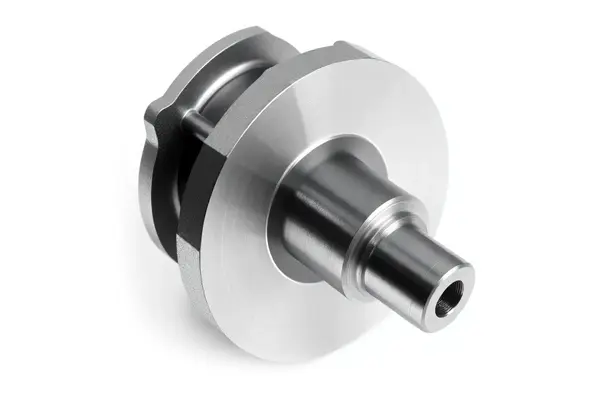
Properties of Mild Steel 1045
Mild Steel 1045 provides ultimate tensile strength of 600–630 MPa and yield strength of 310–320 MPa, giving higher strength than low‑carbon mild steels for shafts, gears, and similar parts. Elongation of 16% and a Brinell hardness of 170–210 HB balance toughness with wear resistance for general engineering use.
| Ultimate tensile strength (MPa) | 600-630 |
| Yield strength (MPa) | 310-320 |
| Young's modulus (modulus of elasticity) (GPa) | 190-205 |
| Elongation at break(%) | 16 |
| Fatigue Strength (MPa) | 80-85 |
| Hardness (Brinell) | 170-210 HB |
| Density (g/cm³) | 7.87 |
| Corrosion resistance | Poor |
| Weldability | Excellent |
| Maximum service temperature(°C) | 480-510 |
| Thermal expansion coefficent (
10-6/°C) |
11.2-12 |
| Thermal conductivity (W/(m⋅°C)) | 51 |
| Electrical resistivity (μΩ.cm) | 16-19 |
| Post-Processing | Cold working & Annealing |
| Magnetism | Semi-magnetic |
| Common Applications | Crankshafts, rollers & cams |
CNC machining Mild Steel 1045
Mild Steel 1045 machines well in the hot‑rolled or normalized condition with standard CNC milling, turning, drilling, and tapping setups. It supports stable chip formation and good tool life when feeds, speeds, and coolant are matched to its 600–630 MPa tensile strength and 170–210 HB hardness. For most shafts, pins, and gears, it comfortably meets standard engineering tolerances; very tight fits or critical bearing surfaces are often finished with a light grinding or polishing pass after machining.
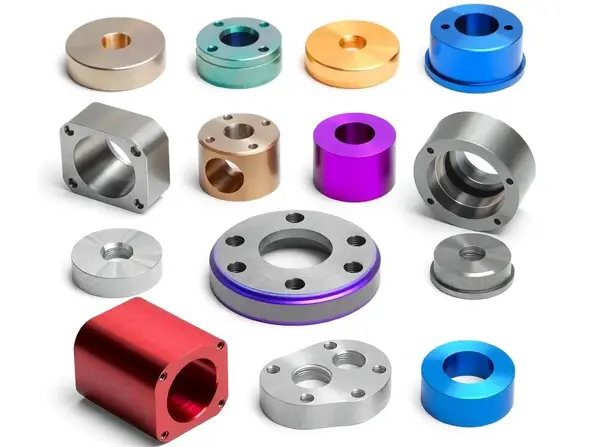
Available Finishes
For Mild Steel 1045 components, appropriate surface finishes help manage wear, friction, and corrosion on working surfaces over the part’s service life. Finishing treatments support dimensional stability and consistent performance by reducing surface defects and smoothing stress concentrations on loaded features. They also improve cleanliness and appearance in applications where exposed steel surfaces must resist contaminants or handling marks. When specifying finishes for Mild Steel 1045 CNC machining, designers typically align finish requirements with the part’s functional zones, such as bearing diameters, seal lands, and mating faces.
| As machined (Standard) | Black oxide |
| As machined (Medium) | Brushed finish |
| As machined (Fine) | Chromate conversion coating |
| Electroless plating | Passivation |
| Electroplating | Polishing |
| Electropolishing | Sand blasting |
| Hand polishing | Tumbling |
| Powder coating | Media blasting |
| Bead blasting |
Frequently Asked Questions
What are the key mechanical properties of Mild Steel 1045 for general engineering use?
Mild Steel 1045 typically offers ultimate tensile strength around 600–630 MPa, yield strength about 310–320 MPa, elongation near 16%, and Brinell hardness in the 170–210 HB range, providing a balance of strength and toughness for shafts, gears, and similar components.
How does Mild Steel 1045 perform in terms of machinability and tolerances?
Mild Steel 1045 provides good machinability in the normalized or hot‑rolled condition, allowing stable chip formation and acceptable tool life when suitable tooling, cutting parameters, and process controls are used. It generally supports standard engineering tolerances for turned and milled parts, with secondary grinding or polishing reserved for surfaces that need very tight fits or low roughness.
What types of applications and operating conditions are suitable for Mild Steel 1045 parts?
Mild Steel 1045 is suitable for moderately loaded rotating and structural parts such as crankshafts, axles, pins, rollers, and couplings, and it is commonly used where good strength, impact resistance, and reasonable weldability are required, but where high corrosion resistance or very high-temperature service are not primary design drivers.