

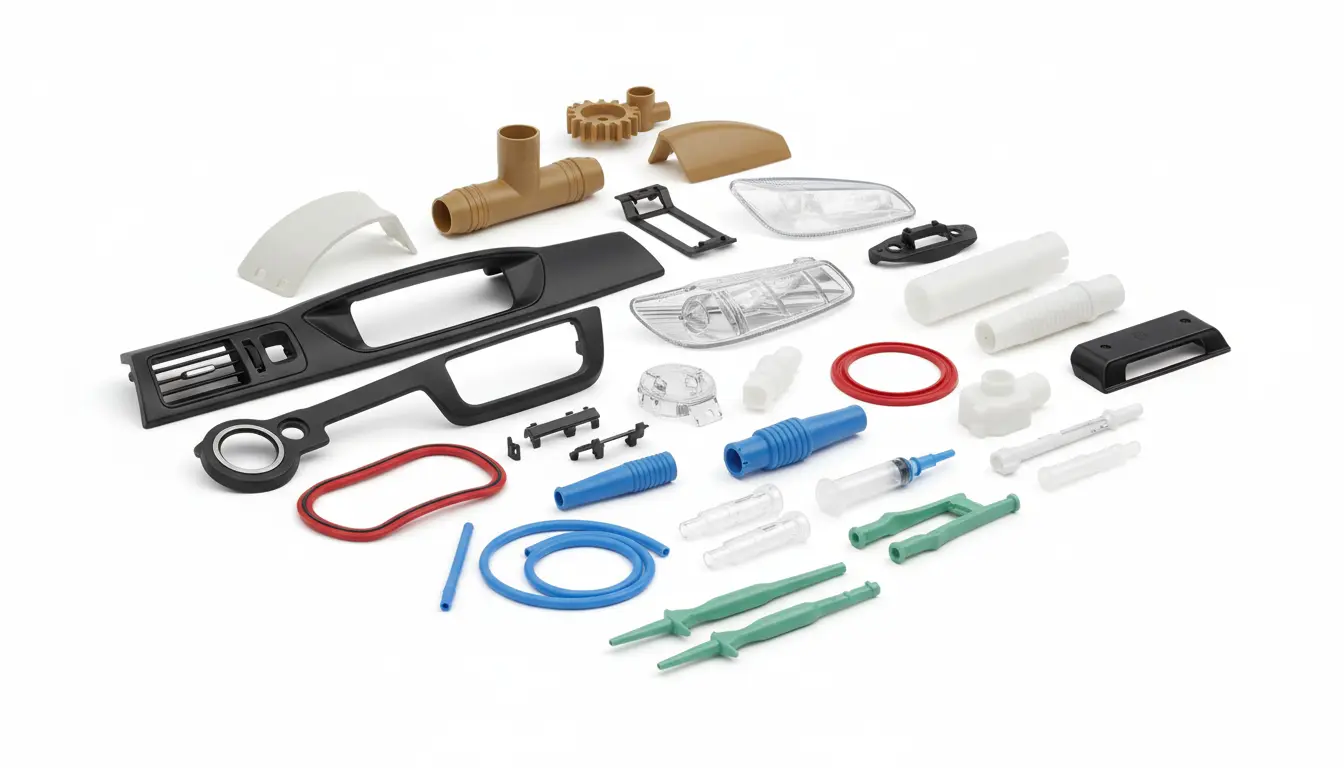
Plastic fabrication is a diverse set of manufacturing processes used to transform raw thermoplastic or thermosetting resins into finished, net-shape components. Chosen based on production volume and geometry, these methods offer lightweight, cost-effective alternatives to traditional metalworking across global industries.
Modern product designers, procurement managers, and engineers rely on plastic fabrication to achieve complex geometries that are either impossible or financially prohibitive to execute in metal. Understanding the mechanics, material compatibility, and economic thresholds of each fabrication process is essential to bringing a viable product to market.
Types of Plastics Used in Fabrication
Selecting the correct polymer family dictates which manufacturing processes are available to your project. Industrial plastics fall into two distinct categories based on their thermal behavior.
Thermoplastics
Thermoplastics soften into a viscous liquid when heated and solidify into a rigid state when cooled. Because this physical transition involves no permanent chemical change, thermoplastics can be repeatedly melted and reshaped, making them highly versatile and compatible with the widest range of high-volume fabrication methods.
- Polyethylene (PE): Highly flexible with exceptional chemical resistance. Extensively used for industrial tubing, chemical containment packaging, and protective films.
- Polypropylene (PP):Known for a high melting point and superior fatigue resistance (living hinges).Common inautomotive interior trim and chemical storage tanks.
- Polyvinyl Chloride (PVC):A durable, flame-resistant polymer dominant in construction infrastructure, municipal piping, and electrical cable insulation.
- Polycarbonate (PC):Offers optical clarity and immense impact resistance. Utilized for safety glazing, machine guards, and protective lenses.
- Acrylonitrile Butadiene Styrene (ABS):A tough engineering plastic featuring high impact strength and an excellent surface finish, ideal for structural enclosures and consumer electronics.
- Polyoxymethylene (POM / Acetal):Characterized by low friction, high stiffness, and dimensional stability, making it the preferred choice for precision gears and mechanical bushings.
Thermosetting Plastics
Thermosetting plastics undergo a permanent chemical cross-linking process during curing. Once cured, their molecular structure is locked; they cannot be remelted or reshaped. If exposed to excessive heat, they degrade rather than melt. Thermosets excel in high-temperature, high-load, and severe chemical environments.
- Epoxies & Polyesters:High-strength resins used alongside glass or carbon fibers to construct structural composites, boat hulls, and aerospace panels.
- Phenolic Resins:Highly flame-resistant with excellent electrical insulation properties,frequentlyspecified for friction components and aerospace interiors.
- Polyurethanes (PU):Exceptionally versatile resins that can be formulated into flexible gaskets, abrasion-resistant wheels, or rigid structural foam housings.
Common Plastic Fabrication Methods
Plastic CNC Machining
Plastic CNC Machining is a subtractive fabrication process where computer-controlled mills, routers, and lathes precisely cut material away from a solid plastic block (known as a slab or billet). Because it relies purely on programming rather than physical molds, it allows for unmatched design flexibility during early product development.
- The Mechanics: High-speed cutting tools follow a pre-programmed CAD/CAM path to remove material layer-by-layer, achieving highly crisp internal corners and complex profiles.
- Volume Limits: Ideal for 1 to 500 units.
- The Trade-offs: There is zero upfront tooling investment, which drastically cuts initial lead times. However, because cycle times are relatively long and material waste is high (chips and shavings cannot easily be reused on-site), the per-part cost remains flat and does not drop significantly at scale.
Injection Molding
Injection Molding is the gold standard for high-volume polymer manufacturing. It involves feeding solid plastic pellets into a heated barrel, where they are melted, mixed, and rammed under immense hydraulic pressure into a heavy, dual-sided steel tool cavity.
-
The Mechanics: Once the molten resin fills every corner of the water-cooled mold, it solidifies within seconds. The mold splits open, ejector pins push the finished part out, and the cycle immediately repeats.
-
Volume Limits: Best suited for 5,000+ units.
-
The Trade-offs: It demands a massive upfront capital expenditure for design, steel, and mold machining, often requiring weeks of validation. However, once the tool is running, it yields the lowest per-part cost of any process, exceptional surface finishes, and absolute physical consistency across millions of units.
Thermoforming (Vacuum & Pressure Forming)
Thermoforming bridges the gap between low-volume prototyping and mass molding. The process begins with an extruded, flat plastic sheet that is clamped into a frame and heated until it reaches its specific softening point.
- The Mechanics: The pliable sheet is draped over a single-sided male or female mold. In vacuum forming, atmospheric air is sucked out from beneath the sheet to pull it tight to the tool. In pressure forming, additional compressed air is applied from the top to force the plastic into sharper corners and finer textures.
- Volume Limits: Highly economical for 250 to 5,000 units.
- The Trade-offs: Molds can be made from affordable materials like aluminum or epoxy composites, drastically cutting tooling costs compared to injection molding. The major constraint is geometric: parts are strictly limited to single-walled, open shapes (like trays or vehicle panels) and cannot feature integrated internal features like thick Boss towers or structural ribs.
Blow Molding
Blow molding mimics traditional glassblowing to create hollow, thin-walled plastic components at scale.
- The Mechanics: A continuous extruder creates a hot, vertical tube of molten plastic called a parison. A dual-sided mold clamps shut around the parison, sealing the bottom. Compressed air is then blown down through the top of the tube, inflating the soft plastic like a balloon until it presses firmly against the cooled walls of the mold cavity.
- Volume Limits: Intended for high-volume production runs exceeding 3,000 units.
- The Trade-offs: This is the most efficient way to manufacture completely hollow parts like commercial bottles, windshield washer fluid tanks, and complex ductwork. However, it is fundamentally restricted to hollow geometries and cannot achieve precise internal features or highly varied wall thicknesses.
Extrusion
Plastic extrusion forces melted polymer continuously through a shaped die to produce a profile with a fixed cross-section.
- Best For: Continuous profiles such as industrial piping, window frames, plastic tubing, and weather stripping.
- Volume Threshold: Continuous / High-volume production.
Rotational Molding (Rotomolding)
Powdered thermoplastic resin is placed into a hollow mold, heated, and biaxially rotated. The powder melts and coats the entire interior surface of the mold uniformly.
- Best For: Large, heavy-duty, seamless hollow shapes like agricultural water tanks, kayaks, and playground equipment.
- Volume Threshold: 50 to 2,000 units.
Advanced Composite & Specialized Molding
- Compression Molding: Uses heat and high pressure to compress a charge of material (often thermosets or reinforced rubber) within a mold. Excellent for thick-walled, high-strength industrial seals or brake pads.
- Reaction Injection Molding (RIM): Mixes two liquid components (typically polyurethanes) that chemically react and cure inside a low-pressure mold. Best for large, lightweight structural skins and equipment enclosures at medium volumes.
- Pultrusion: Pulls continuous fibers through a liquid resin bath and a heated forming die. This continuous process produces high-strength structural profiles, beams, and rods that rival steel in strength-to-weight performance.
Additive Manufacturing (3D Printing)
- FDM (Fused Deposition Modeling): Extrudes thermoplastic filament layer-by-layer. Ideal for fast, low-cost visual prototypes and simple fixtures (1–100 units).
- SLA/SLS (Stereolithography / Selective Laser Sintering): Uses UV lasers to cure liquid resin or sinter nylon powder. Best for highly intricate, dense, and complex functional components without the need for support structures (1–200 units).
How to Choose the Right Plastic Fabrication Method
To select the ideal fabrication process, engineers must balance production economic metrics against geometry constraints.
1. Evaluate Production Volume
Your total volume dictates your tooling amortization limits:
- Low Volume (1–500 units): Avoid hard tooling entirely. Lean on CNC machining or additive manufacturing to keep initial capital expenditure at zero.
- Medium Volume (500–5,000 units): Utilize thermoforming, RIM, or rotational molding, which utilize lower-cost single-sided or low-pressure aluminum tooling.
- High Volume (5,000+ units): Transition to injection molding or blow molding. While upfront tooling costs are significant, the minimal per-part labor cost delivers the quickest return on investment (ROI).
2. Map Part Geometry to the Process
- Complex Internal Features: If your design features intricate ribs, boss towers, and undercuts, it requires Injection Molding or SLS 3D Printing.
- Hollow Enclosures: Large, completely hollow structures can only be economically produced using Blow Molding (for thin-walled containers) or Rotational Molding (for thick-walled tanks).
- Large, Shallow Components: Broad covers and equipment doors are best suited for Thermoforming, avoiding the massive molds needed to injection-mold huge parts.
3. Review Tolerances and Surface Finishes
- Tight Precision (±0.1 mm to ±0.25 mm): Demands CNC machining, injection molding, or SLA printing.
- Standard Precision (±0.5 mm to ±1.0 mm): Acceptable for thermoforming, compression molding, and rotational molding, where secondary trimming operations usually establish critical dimensions.
Direct Comparison: Injection Molding vs. Thermoforming
For product teams designing equipment enclosures, medical device skins, or electronic housings, the choice almost always narrows down to injection molding vs. thermoforming.
| Evaluation Factor | Injection Molding | Thermoforming |
|---|---|---|
|
Tooling Expense |
Very High (requires dual-sided steel tooling) |
Low to Moderate (uses single-sided wood or aluminum tools) |
|
Target Volume Scale |
High-volume production (5,000+ pieces) |
Low-to-mid volume production (250–5,000 pieces) |
|
Geometric Liberty |
Excellent; handles varied wall thicknesses, ribs, and bosses |
Limited; parts must feature a uniform wall thickness |
|
Production Lead Time |
8 to 16 weeks for tool steel validation |
4 to 10 weeks to initial part delivery |
|
Unit Manufacturing Cost |
Extremely low once tooling expenses are amortized |
Higher per-unit operational costs due to sheet stock costs |
Advantages, Limitations, and the Green Shift
Key Advantages
- Weight Reduction: Plastics offer high strength-to-weight ratios, replacing heavy metal castings to cut logistics costs and improve fuel efficiency in automotive and aerospace fields.
- Design Consolidation: Injection molding allows designers to integrate brackets, snaps, and living hinges directly into a single component, eliminating secondary assembly labor.
- Inherent Corrosion Protection: Polymers naturally resist moisture, harsh acids, and galvanic corrosion, removing the need for post-fabrication chemical plating or painting.
Core Limitations
- Thermal Creep & Degradation: Unlike structural metals, commodity plastics lose physical integrity at elevated operating temperatures and can suffer from mechanical creep over long periods under load.
- Sourcing Complexity: With thousands of modified polymer grades available, picking an incompatible compound can cause premature environmental stress cracking (ESC).
The Evolution Toward Sustainable Manufacturing
To address the long-term environmental footprint of traditional polymers, modern plastic fabrication increasingly utilizes eco-friendly alternatives:
- Bio-Resins & Bioplastics: Polylactic Acid (PLA) and polyhydroxyalkanoates (PHA) replace petroleum bases with renewable cornstarch or sugarcane stocks.
- Post-Consumer Recycled (PCR) Resins: Advanced injection and extrusion lines now regularly process blends containing high percentages of ocean-bound or post-industrial recycled plastics, reducing virgin resin consumption.
Step-by-Step: The Plastic Fabrication Lifecycle
- Design & Engineering (DFM): Engineers build 3D CAD models ensuring proper wall thicknesses, corner radii, and draft profiles match the targeted manufacturing equipment.
- Material Characterization: Selecting an exact polymer formulation by reviewing tensile strength, continuous service temperatures, and chemical exposure charts.
- Tooling Engineering: Machining steel injection cores, aluminum vacuum tools, or programming multi-axis CNC paths.
- Resin Conditioning: Plastic pellets are thoroughly dried in desiccant hoppers to remove ambient humidity, avoiding cosmetic splay and internal structural voids during forming.
- Primary Processing: The core step where the material is shaped via molding, cutting, or extruding under tightly regulated thermal cycles.
- Secondary Finishing: Parts undergo automatic or manual deflashing, multi-axis CNC trimming, heat-staking insert installation, painting, or EMI shielding application.
- Quality Assurance (QA): Utilizing automated Coordinate Measuring Machines (CMM) to verify critical dimensions against the print, backed by material traceability logs.
Work With a Verified Plastic Fabrication Partner
Navigating polymer chemistry and scaling production demands proven industrial experience. Engaging early with a manufacturing expert protects your project from expensive tooling reworks and long delays.
Clarwe provides an end-to-end global custom manufacturing platform built to streamline your procurement pipeline. From initial low-volume CNC prototyping to multi-cavity production injection molding, Clarwe’s engineer-led DFM reviews and manufacturing network ensure your components deploy on time, to specification, and within budget.
Ready to optimize your production design? Upload your CAD file today for an online quote and a comprehensive manufacturing analysis.
Frequently Asked Questions
What is the cheapest plastic fabrication method?
For low volumes (1–100 parts), FDM 3D printing and CNC machining are the cheapest because they require no upfront tooling costs. For long-term production runs exceeding 5,000 units, injection molding offers the lowest per-part cost despite its high initial setup fee.
What is the difference between thermoplastics and thermosets?
Thermoplastics can be melted and reshaped multiple times because they do not change chemically when heated. Thermosetting plastics form permanent chemical bonds when cured; they cannot be remelted, providing superior heat resistance but making them harder to recycle.
Which plastic fabrication method achieves the tightest tolerances?
Plastic CNC machining and injection molding deliver the tightest tolerances, regularly achieving accuracies between ±0.1 mm and ±0.25 mm. For fine prototype details, SLA 3D printing offers comparable precision.
Can thermosetting plastics be recycled?
Unlike thermoplastics, thermosetting plastics cannot be remelted and molded again. However, they can be mechanically ground down into fine filler materials for concrete, protective coatings, or new composite panels.