


Introduction
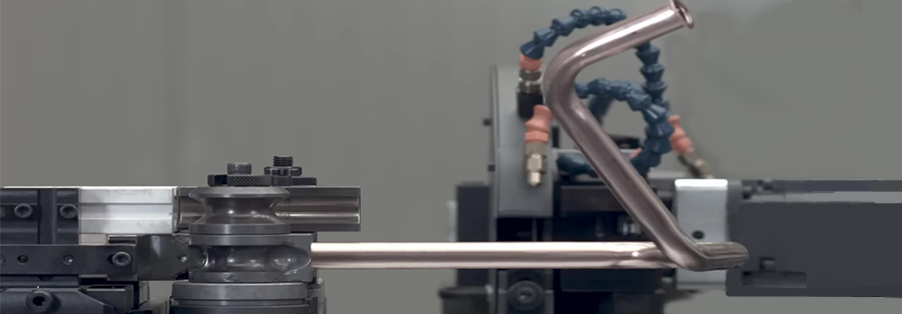
What is CNC Tube Bending
Tube Bending Terminology
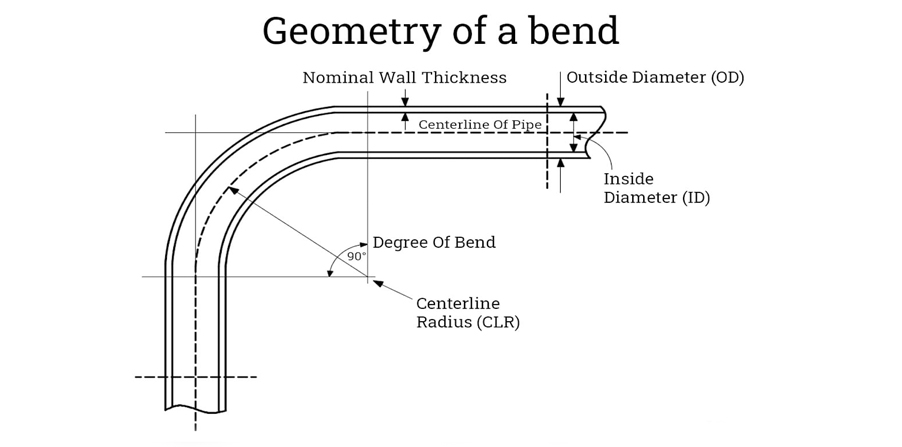
- Outer diameter (OD): External diameter of the tube and the primary sizing reference for dies, mandrels, and clamps.
- Inner diameter (ID): OD minus twice the wall thickness; it controls internal flow area and affects mandrel sizing.
- Wall thickness (WT): Distance between OD and ID; thin walls are more prone to wrinkling, ovality, and thinning during bending.
- Center-line radius (CLR): Bend radius measured at the tube centerline; a smaller CLR indicates a tighter bend and higher forming loads.
- Degree of bend (DOB): Included bend angle programmed on the CNC (for example, 45°, 90°, 180°).
- Ovality: Change in roundness of the tube cross-section after bending, typically expressed as a percentage difference between maximum and minimum diameter.
A simple wall factor metric, often defined as WF = OD / WT, is used in many design guides to identify thin-wall conditions that may require mandrel support.
Tube Bending Mechanics, Defects, and Tolerances
During bending, the outer wall of the tube stretches in tension and tends to thin, while the inner wall compresses and can thicken or wrinkle. Understanding these mechanics helps engineers choose suitable bending methods and design parts that stay within strength and quality limits.
- Common issues include:
- Wall thinning: Excessive tensile strain on the outer radius reduces wall thickness and can weaken pressure or structural lines.
- Wrinkling: Too much compressive strain on the inner radius causes waves or buckling, especially in thin-wall or large-diameter tubes.
- Spring-back: After unloading, the tube partially returns toward its original shape; bending programs must over-bend to reach the final angle.
- Ovality and flattening: The round cross-section becomes oval, which may affect sealing interfaces, fittings, and assembly clearances.
Realistic tolerances depend on method, tooling, and material, but CNC rotary draw and mandrel bending typically achieve tighter angular and positional control than compression, roll, or press bending.
Tube Bending Design Tips and Minimum Bend Radius Guidelines
- Start with a cold bend radius of about 2-3x tube OD for many materials and applications; tighter radii often require mandrel and wiper tooling.
- Treat wall factor values above roughly 70 as thin-wall conditions that demand more careful process selection and support tooling.
- Maintain at least 2x OD of straight length between bends and between a bend and a tube end where possible to allow proper clamping.
- Limit the number of different bend radii in a single part to reduce tooling changes, setup time, and cost.
- Define acceptable wall thinning and ovality ranges for critical pressure or structural applications and reflect these limits on drawings.
Design guideline values (rule of thumb)
| Design aspect | Typical rule of thumb | Notes |
|---|---|---|
| Standard cold bend radius | ≈2-3x tube OD for many alloys | Tighter radii increase forces and defect risk. |
| Large-radius roll bends | ≥7x tube OD for roll/push bending | Common for coils, arches, and long curves. |
| Approximate minimum radius | ≈1-1.5x tube OD with specialized tooling | Very tight radii usually require mandrel + wiper. |
| Ovality allowance | Around 1-2% per 25 mm of OD as a rough starting point | Actual acceptable ovality depends on standards. |
| Thin-wall indicator | Wall factor (OD / WT) > 70 often treated as thin-wall | Higher WF generally needs more internal support. |
These values are approximate and should always be confirmed with the tube bender for specific materials and geometries.
Calculating Minimum Bend Radius for Tubing
Minimum bend radius is the smallest CLR that can be used without unacceptable wrinkling, thinning, or cracking. Many design guides start with a recommended radius (such as 3x OD) and reduce it stepwise while evaluating wall factor, tooling options, and required tolerances for the application.
Explore Clarwe’s CNC tube bending capabilities to see typical size ranges, materials, and bending methods we support.
Types of Tube Bending Processes (CNC and Conventional)
Different tube bending methods balance precision, speed, tooling cost, and flexibility in different ways. The sections below describe the most common processes used in CNC and semi-automatic production.
Rotary Draw Tube Bending: Tight-Radius, High-Precision Bends
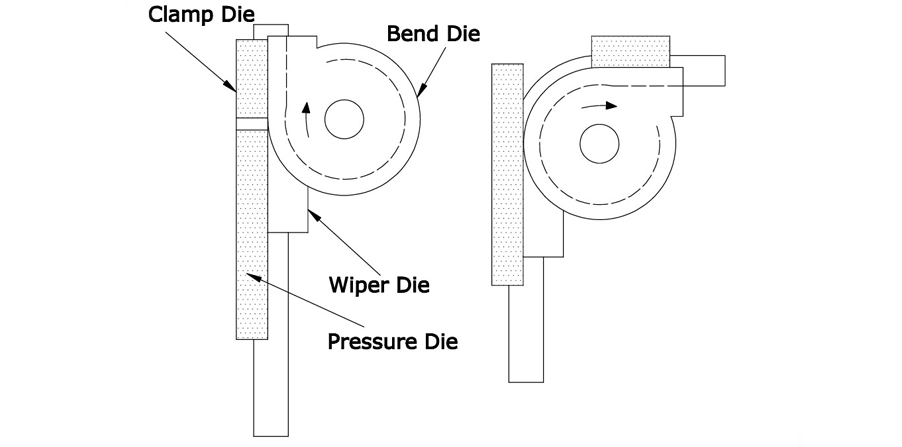
Rotary draw bending is one of the most widely used methods for precise, repeatable tube bends, especially where tight radii and accurate geometry are required. The tube is clamped to a bend die and drawn around it while a pressure die and, when needed, a mandrel support the tube to limit distortion.
- Best suited for: Automotive and motorcycle headers, roll cages, handrails, hydraulic lines, frames, and precision assemblies.
- Advantages: High accuracy on angle and radius, good surface finish, and strong control over ovality and wall thinning with appropriate tooling.
- Limitations: Higher tooling and setup cost for each OD/CLR combination, and slower than basic press bending for very loose-tolerance components.
Mandrel Tube Bending for Thin-Wall and High-Pressure Tubes
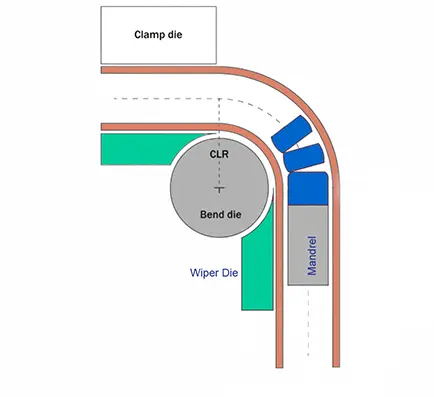
Mandrel bending is a form of rotary draw bending that uses an internal mandrel to support the tube ID during bending. This internal support significantly reduces wrinkling and flattening, enabling tighter radii and thinner-wall tubes to be bent reliably.
- Best suited for: Thin-wall stainless and aluminum tubes, high-pressure hydraulic and fuel lines, tight-radius exhausts, and visible cosmetic tubing.
- Advantages: Excellent cross-section control, minimal wrinkling, and the ability to achieve small CLR/OD ratios while keeping wall thinning within limits.
- Limitations: More complex tooling and setup, narrower process window, and higher tooling maintenance requirements.
Compression Tube Bending for Simple, Large-Radius Bends
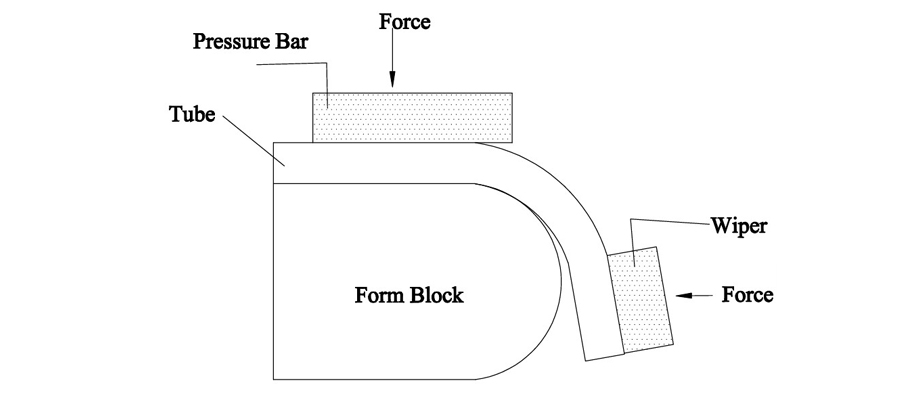
Compression bending clamps the tube at one end while a form block swings around to push and wrap the tube against a fixed radius block. It is suitable for relatively large radii and simple geometries where very tight tolerances are not required.
- Best suited for: Furniture frames, handrails, simple structural components, and low-pressure lines.
- Advantages: Simple equipment, lower tooling costs, and good productivity for standard bend radii.
- Limitations: Less control over ovality and wrinkling than rotary draw, making it less suitable for tight radii or thin-wall precision tubing.
Roll Tube Bending for Coils and Large Arcs
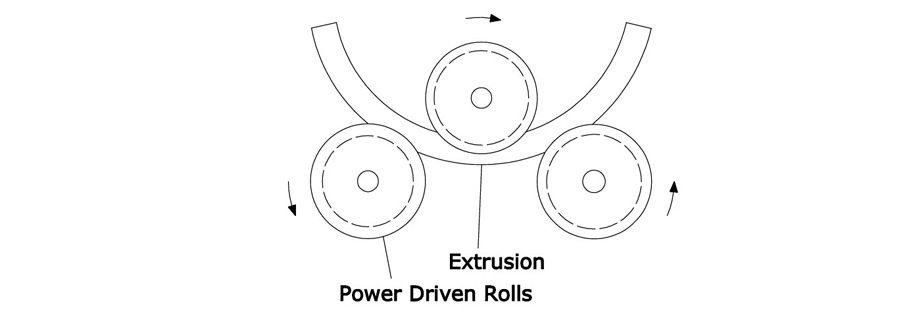
Roll bending uses three or more rollers to gradually curve the tube into large-radius arcs, coils, or spirals. Instead of a single sharp bend, the tube passes multiple times through the rolls until the desired curvature is achieved.
- Best suited for: Large rings, architectural arches, long sweeping curves, and heat exchanger coils.
- Advantages: Capable of very large radii and long parts, well-suited to larger diameters and extended arc lengths.
- Limitations: Not ideal for small, localized radii; angle accuracy is lower than rotary draw and often requires trial adjustments.
Press Tube Bending for High-Volume, Simple Geometries
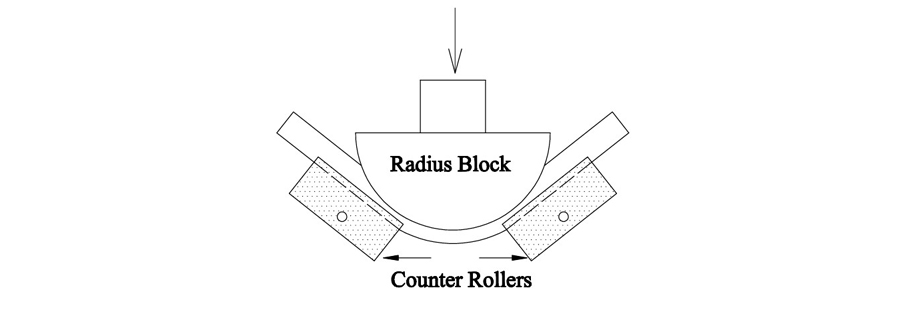
Press bending uses a punch and die set in a press to force the tube into a required shape. It is typically used for simple, high-volume parts where moderate amounts of ovality and wall thinning are acceptable.
- Best suited for: HVAC components, basic structural parts, and commodity bends with generous tolerances.
- Advantages: High throughput for simple geometries and relatively low equipment cost.
- Limitations: Lower precision than rotary draw, more prone to flattening and thinning on tight bends, and less flexible when different radii are required.
Hot and Induction Tube Bending for Large Pipes and Heavy Sections
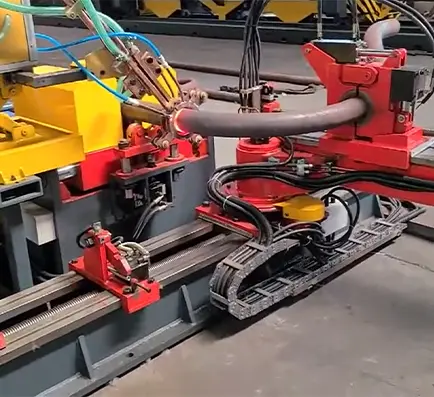
Hot bending and induction bending use controlled heating to reduce forming forces and allow bends on large or difficult-to-form materials. Induction coils or furnaces heat a localized zone of the tube, which is then bent around a form and cooled to lock in the shape.
- Best suited for: Thick-wall pipes, large diameters, and demanding alloys used in pipelines and heavy structural applications.
- Advantages: Enables tighter radii on heavy sections and reduces the risk of cracking in high-strength materials compared with cold bending.
- Limitations: Requires specialized equipment, slower cycle times, and careful control of heat-affected zones and final mechanical properties.
Tube Bending Method Comparison: Precision, Radius, and Applications
Process comparison table
| Bending method | Precision level | Typical CLR range | Typical applications |
|---|---|---|---|
| Rotary draw | High | Tight to medium (≈1.5-4x OD) | Automotive, frames, precision industrial assemblies |
| Mandrel bending | Very high | Very tight (≈1-1.5x OD) | Thin-wall, high-pressure, visible cosmetic tubing |
| Compression bending | Medium | Medium to large (≥2.5-4x OD) | Furniture, handrails, simple frames |
| Roll bending | Medium | Large sweeping (≥7x OD) | Coils, arches, large curves, heat exchangers |
| Press bending | Low-medium | Medium radii | Simple, high-volume commodity bends |
| Hot/induction bending | Medium-high | Tight on heavy sections (≈2-5x OD) | Large-diameter pipe, heavy structural members |
Above CLR ranges are typical values drawn from tube bending design guides and should be confirmed for each specific alloy and geometry.
How to Choose the Right Tube Bending Method for Your Design
Selecting a tube bending method depends on part geometry, material, tolerance, and cost targets.
Key decision points include:- Precision and tolerances: Tight angular and positional tolerances usually call for CNC rotary draw or mandrel bending.
- Tube size and wall thickness: Thin-wall small-diameter tubes often benefit from mandrel support, while large thick-wall sections may require hot or induction bending.
- Bend radius and geometry: Tight CLR/OD ratios and multiple bends close together favor rotary draw or mandrel bending; sweeping curves are better suited to roll bending.
- Volume and cost: High-volume simple shapes can justify compression or press bending, whereas flexible mixed-volume production often relies on CNC rotary draw systems.
FAQs
What is the difference between pipe bending and tube bending?
Pipe is usually specified by nominal size and schedule, while tube is specified by precise outer diameter and wall thickness. Tube bending generally requires tighter dimensional control, whereas pipe bending often focuses on flow and pressure performance.What is the minimum bend radius for tube bending?
The minimum bend radius is the smallest center-line radius a tube can be bent to without unacceptable wrinkling, thinning, or cracking. Many designs start at 2-3 times the tube outer diameter for cold bending and move to tighter radii only when supported by suitable tooling and process capability.How do I choose the right tube bending method for my design?
The choice depends on required precision, tube size and wall thickness, bend radius, and production volume. Tight-tolerance, tight-radius bends usually need CNC rotary draw or mandrel bending, while large curves may use roll bending, and simple high-volume parts may use compression or press bending.What are the most common types of tube bending processes?
The most common processes include rotary draw bending, mandrel bending, compression bending, roll bending, press bending, and hot or induction bending. Each method offers a different balance of precision, tooling cost, and flexibility, so it is important to match the process to part tolerances and geometry.What tube bending design tips improve manufacturability?
Helpful tips include using standard radii (often around 2-3x OD), minimizing the number of different bend radii, keeping adequate straight lengths between bends, and avoiding very tight radii unless functionally necessary. Following these guidelines can reduce custom tooling, setup time, and scrap while improving consistency across batches.How does wall thickness affect tube bending quality?
Thicker walls generally allow tighter bend radii and better resistance to wrinkling but increase forming force and part weight. Thin-wall tubes require careful control of bend radius, tooling support, and acceptable ovality or wall-thinning limits to prevent defects.What tolerances are realistic for CNC tube bending?
Realistic tolerances vary, but CNC rotary draw and mandrel bending typically achieve tighter angular and bend-to-bend positional tolerances than compression or roll bending. Designers should specify tighter tolerances only where function demands them and coordinate with the tube bender early to confirm what is achievable for a given tube size and material.About this blog
This blog summarizes established tube bending concepts and rules of thumb from industry design guides and manufacturer resources so engineers can compare methods and design for manufacturability more effectively.